

Virgin Galactic homepage link
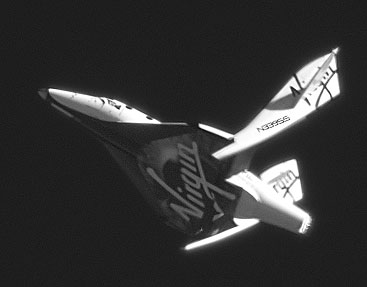
First Feather Flight of SpaceShipTwo.
Photo by Clay Center Observatory/Virgin Galactic
Early on Wednesday, May 4, 2011, in the skies above Mojave Air and Spaceport, CA, SpaceShipTwo underwent its third test flight in less than two weeks — such marks another major milestone on the path to powered test flights and commercial operations. SpaceShipTwo (SS2), named VSS Enterprise, has now flown solo seven times since its public roll-out in December 2009. This latest flight saw a 6:43 a.m. (local) runway take off for VSS Enterprise, attached to its WhiteKnightTwo (WK2) carrier aircraft, VMS Eve. At the controls of the of the spaceship were Scaled Composites’ test pilots Pete Siebold and Clint Nichols, while Mark Stucky, Brian Maisler and Brando Inks crewed the purpose built, all composite, twin fuselage WK2.
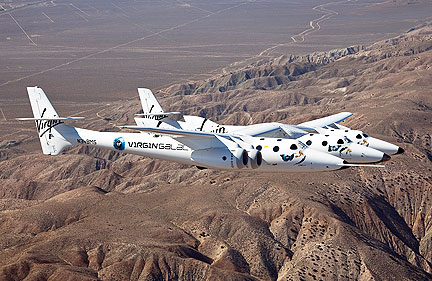
VSS Enterprise' first flight over the Mojave, photo by Mark Greenberg
George Whitesides, CEO and President of Virgin Galactic, said, “This morning’s spectacular flight by VSS Enterprise was its third in 12 days, reinforcing the fast turnaround and frequent flight-rate potential of Virgin Galactic’s new vehicles. We have also shown this morning that the unique feathering re-entry mechanism, probably the single most important safety innovation within the whole system, works perfectly. This is yet another important milestone successfully passed for Virgin Galactic, and brings us ever closer to the start of commercial operations. Credit is due to the whole Scaled team, whose meticulous planning and great skill are changing the course of history.”
Pete Siebold, who, along with Clint Nichols, piloted the spaceship, added, “In all test flight programs, after the training, planning and rehearsing, there comes the moment when you have to go up there and fly it for real. This morning’s flight was a test pilot’s dream. The spaceship is a joy to fly and the feathered descent portion added a new, unusual but wonderful dynamic to the ride. The fact that it all went to plan, that there were no surprises and that we brought VSS Enterprise back to Mojave safe and sound is a great testament to the whole team.”
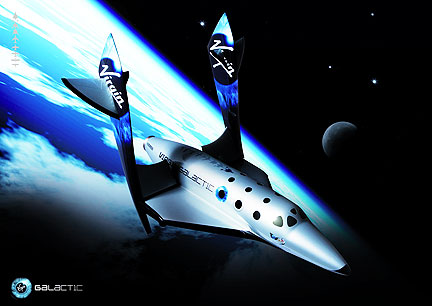
Artistic rendition of SpaceShipTwo with wings in feathered position, courtesy of Virgin Galactic
Once out of the atmosphere, the entire tail structure of the spaceship can be rotated upwards to about 65 degrees. The feathered configuration allows an automatic control of attitude with the fuselage parallel to the horizon. This creates very high drag as the spacecraft descends through the upper regions of the atmosphere. The feather configuration is also highly stable, effectively giving the pilot a hands-free re-entry capability, something that has not been possible on spacecraft before, without resorting to computer controlled fly-by-wire systems. The combination of high drag and low weight (due to the very light materials used to construct the vehicle) mean that the skin temperature during re-entry stays very low compared to previous manned spacecraft and thermal protection systems such as heat shields or tiles are not needed. During a full sub-orbital spaceflight, at around 70,000ft following re-entry, the feather lowers to its original configuration and the spaceship becomes a glider for the flight back to the spaceport runway.