

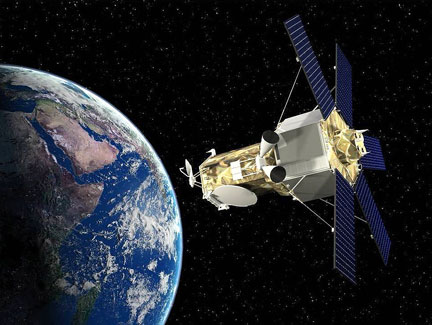
Artistic rendition of GeoEye-2 satellite, image courtesy of Lockheed Martin
GeoEye-2 will be launched aboard an Atlas V rocket provided by Lockheed Martin Commercial Launch Services and will be operational in early 2013. Once fully operational, GeoEye-2 will be the highest resolution commercial satellite in the world. In addition, it will have significant improvements in performance capabilities, such as enhanced tasking and the ability to collect more imagery at a faster rate. In development under a fixed-price contract with GeoEye to support the National Geospatial-Intelligence Agency's EnhancedView commercial imagery program, GeoEye-2 will provide intelligence analysts, war fighters, and decision makers map-accurate images at an increased resolution, with a greater spacecraft response rate and level of performance reliability unmatched by existing spacecraft. GeoEye-2 is based on the latest generation of the LMx configure-to-order low Earth orbit bus product line initiated with Lockheed Martin-built IKONOS satellite, and it features a new high-resolution ITT camera that has been in development for more than two years.