

Each year two teams of Master students carry out literature surveys and critical reviews of the subject matter as background preparation for the main Team Project work. Students work in their respective teams to collectively identify a focused topic for their main study project. Using their imagination and initiative, the students develop their skills to participate effectively in an international team while working towards an innovative, focused, conceptual study, to create a professional printed report and presentation of the results.
Throughout this conception phase, students are faced with the task of organizing their teams effectively to carry out project work while learning how to reach solutions in circumstances where conflicting requirements often emerge and compromises must be made.
This year teams presented 2 visionary Space Projects:
Kourou, a “Vision” beyond 2030
The main goal of the Vision forwarded in the project is to inspire decision makers, active space players, and the general public illustrating the potential of Kourou as a human-rated launch site. The report communicates a realistic picture of Kourou by outlining the tools, techniques, and procedures required to realize this future. The fundamental question raised is simply: why not?
Today’s human spaceflight market is rapidly evolving. With the flight of the last Space Shuttle due mid 2011, the bold Chinese entry in 2003, and the successful tests of SpaceX’s Dragon capsule by late 2010, a decision for Europe to enter this field of Human Space Flight is overdue. ISU students believe a progressive approach is needed to kindle the fire and take Kourou to the next level. The chosen decade of the 2030s is far enough to allow a decision to take place in the next five years and implement the expansion inside the 15-year window.
It is close enough to be realistic, and allows ambitious futuristic concepts to be suggested. Both the commercial Human Space Flight (HSF) kick-off estimated as early as 2015 and the long periods required to develop HSF capabilities, further emphasize the timeliness of a European decision.
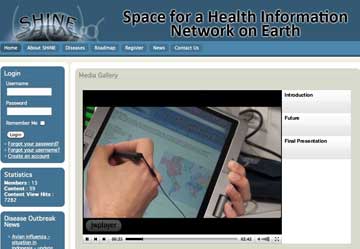
SHINE: Space For A Health Information On Earth
Infectious diseases still present major issues in developing countries and affect millions every year. The mortality rate due to infectious diseases is proportional to their rate of transmission, and it is therefore important to concentrate on the prevention and monitoring of these diseases.
The SHINE Roadmap was developed to evaluate the current and possible future global health scenarios and identify what technologies exist to aid global health initiatives with an outlook towards 2030. Notably, it shows how space-based technologies can complement other resources in the e-Health industry and how information and communication technologies can maximize the accessibility to information provided by these technologies. The SHINE Web Platform was designed to fill gaps identified in the SHINE Roadmap, and tie together existing health monitoring information into an intuitive database. This database allows users to link diseases and their environmental indicators to satellite instrumentation and data providers able to provide the necessary remote sensing data and analysis. The SHINE web platform is accessible at.
On May 12th, ISU Master Students presented their projects in front of an academic panel composed of the ISU Dean and faculty. Professor Nikolai Tolyarenko, Director of ISU’s Masters Programs was chairing the session.
Note: The presentations were recorded and will be made available for later viewing via ISU’s Video on Demand Service.