

.....of the new European launch vehicle, Vega. Scheduled for February 13th this year, Vega's first mission is to carry and deploy the Italian research satellite LARES. As Europe's largest independent supplier of space products, RUAG Space played a major role in the Vega project and is responsible for the development of the launcher's payload fairing and onboard computer. With Vega, the family of European launchers now also caters to the smaller end of the market. Measuring in at a height of some 30 meters, this launch vehicle is designed to carry small to medium-sized satellite payloads into low Earth orbits. Vega can carry a payload of approximately 1,500 kilograms to an altitude of 700 km, making it particularly suitable for deploying satellites designed for Earth observation, meteorology and scientific studies. Vega has a lift-off mass of approximately 137 metric tons. The new launcher was developed as part of an ESA program funded by Italy, France, Spain, Belgium, the Netherlands, Switzerland and Sweden. The industrial prime contractor is the Italian consortium ELV, while the launch service provider is the company Arianespace, which also runs the French Guiana-based launch operations for the Ariane and Soyuz launchers. And RUAG Space developed the payload fairing and the onboard computer for the Vega launcher.
Vega's payload fairing is built by RUAG Space in Zurich. The fairing, which is nearly 8 meters long, forms the nose cone of the rocket. Prior to launch, it protects the satellites from high temperatures, solar radiation, dust, moisture and rain at the launch site. During the first few minutes of flight, the primary job of the fairing is to protect the satellites it encapsulates from extreme noise, frictional heat and mechanical loads. Once the rocket has passed through the Earth's atmosphere after the critical first three minutes of flight, the fairing has fulfilled its purpose and can be jettisoned. The engineers at RUAG Space have more than 40 years' experience in making sure that the rocket nose cone survives those all-important first three minutes intact. Since the early days of the European Ariane program, Switzerland has been responsible for producing the nose cones of the western European launch vehicles. RUAG Space is now the world's leading supplier of payload fairings using composite technology. RUAG fairings are used on both the European Ariane 5 and the American Atlas V 500 launch vehicles.
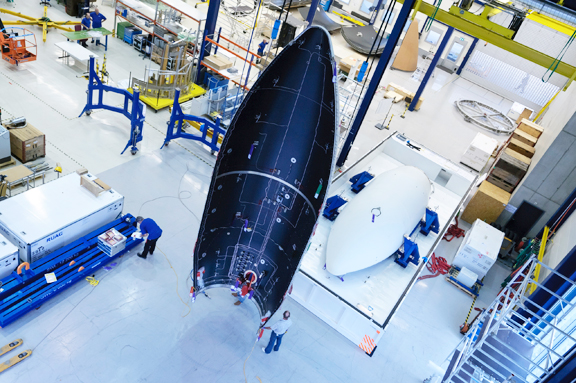
The Vega fairing undergoing work at RUAG Space, photo courtesy of RUAG Space.
The Vega fairing uses the same sandwich construction as the Ariane and Atlas fairings. It consists of four shell sections with an aluminum honeycomb core covered with layers of carbon fiber reinforced plastic. With a diameter of 2.60 meters and a length of nearly 8 meters, the fully equipped composite fairing weighs just 530 kilograms thanks to its innovative design. The exterior of the fairing is covered with cork insulating tiles to protect it from the frictional heat generated as it passes through the Earth's atmosphere. The launcher's onboard computer and the telemetry antennas are built by RUAG Space Sweden. Compared with the onboard computer used in Ariane 5, the Vega computer offers far more processing power, yet is significantly smaller and lighter. On its maiden flight, the new launcher will be carrying the LARES satellite (an acronym for Laser Relativity Satellite). Developed by ASI, the Italian Space Agency, this passive research satellite is made from a single piece of tungsten alloy, forming a sphere covered with 92 retroreflectors, Scientists hope that LARES will help them measure the Lense-Thirring precession, a gravitomagnetic effect predicted by general relativity. The Vega launcher will also be deploying a series of experimental microsatellites.