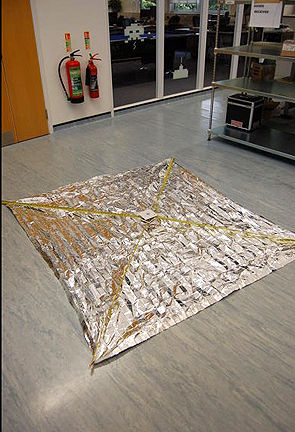
[SatNews] This new technology is believed will be of use in de-orbiting CubeSats...
Following the award of a Feasibility Study from the Technology Strategy Board, engineers from Clyde Space and the University of Glasgow combined their skills to produce a deployable dragsail for CubeSats that operates using stored energy. The objective of the study was to find a reliable method of de-orbiting spacecraft once they have completed their mission. Orbital debris consisting of dead spacecraft is becoming an increasing problem and there is now an obligation for most space fairing nations to ensure that all spacecraft can be de-orbited (or parked in a graveyard orbit) within at least 25 years of the end of their mission. De-orbiting can be a difficult and expensive exercise and, for tiny spacecraft such as CubeSats that weigh less than 10kg, it can sometimes be an impossible requirement to achieve within tight budget constraints.
Clyde Space have a proven track record of providing reliable and cost effective component solutions for CubeSats and the Company has realized that an affordable solution for end of mission de-orbit is desperately needed by the CubeSat community. The work completed on the feasibility study has proven that it is possible to produce a cost effective solution for de-orbiting CubeSats. Following multiple iterations of the stored design, including a number of prototypes, Clyde Space' latest prototype design has reliably completed multiple trial deployments. The feasibility study focussed mainly on the mechanical aspects of the deployment mechanism; future work will involve further work on the sail material and folding approach and also the mechanical interface to the sail assembly. The dragsail product should be ready within the next 12 months.