

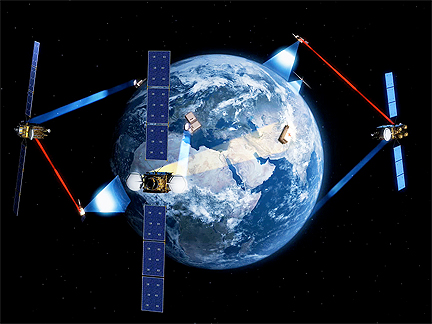
Artist impression of European Data Relay Satellite (EDRS) system, courtesy of ESA
This marks the moment when it moves ahead with a green light from its first customer, the Global Monitoring for Environment and Security initiative from the European Union (GMES). EDRS will provide a telecommunications network that is fast, reliable and seamless, making real-time information from satellites available on demand. EDRS will be the first commercially operated data relay system to deliver services to the Earth observation community. It is being built through a Public–Private Partnership (PPP) between ESA and Astrium Services, using payloads carried by two satellites in geostationary orbit, hovering 36,000km above the Equator, where their speed matches Earth’s rotation. Data transmitted from satellites in lower orbits to either of these EDRS payloads can then be relayed to the ground.
The payload includes a laser terminal developed by TESAT of Germany to transmit up to 1.8 gigabits per second over distances in excess of 40,000km, between the lower satellites and EDRS in geostationary orbit. A design review board of senior members from ESA, Astrium and the DLR German Aerospace Center approved the entire system design: From the satellites to the support that will be required from the ground. The industrial organization is fully in place with all subcontracts negotiated and ESA’s partner Astrium Services ready to begin production.
The first of the two EDRS payloads will be carried on the Eutelsat EB9B satellite, starting operation in 2014, built by Astrium and positioned at 9 degrees East over the Equator. The second satellite, planned for launch in 2016, will carry the second EDRS payload as well as the Hylas-3 payload from the UK’s Avanti Communications. This satellite will be built by Germany’s OHB using the SmallGEO platform, currently under development by OHB under ESA contract.