

 [SatNews] Astrium has entered into an agreement with ECAPS, a company of the Swedish Space Corporation Group (SSC), to jointly develop a "green" propulsion system concept, which is based on ADN technology. This concept focuses on the target of directing the future of space propulsion technology to sustainability, eco-friendliness and reduced toxicity on ground, and easy and safe operation capabilities in space. Under the terms of this agreement Astrium will initially complement its existing capabilities in the field of in-space propulsion technologies. Furthermore, this landmark initiative supports Astrium's intention to be an environmental-friendly company.
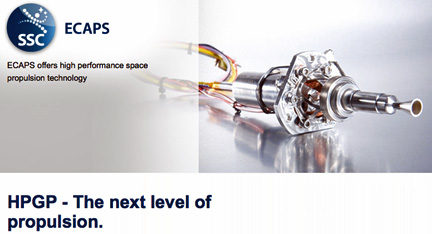 The cooperation sees long-term research, marketing and production collaboration between the two entities in order to further advance their cutting edge propulsion capacities. Under the new agreement Astrium will bring in its expertise and experience in manufacturing, integration and provision of satellite platforms and propulsion systems while ECAPS will provide its expertise in the development and qualification of Ammonium Dinitramide based technologies, in particular thrusters and propellant.
Dr. Andreas Rohne, Director of Astrium’s Propulsion and Equipment, said, “This agreement is the result of intense discussions following several years of cooperation between Astrium and ECAPS. Astrium is to pursue this long-term strategic partnership for the sake of both parties and the space industry in general”.
The signing of this agreement marks the beginning of a long-term partnership between Astrium and ECAPS for the development of propulsion systems for future satellite propulsion systems, roll control systems for launch vehicles and many other propulsion applications yet to come.
Astrium is best known as the prime contractor for Ariane 5, the Columbus Space Laboratory, the Automated Transfer Vehicle for the International Space Station and for its leading-edge geostationary telecommunications satellites and Earth observation spacecraft. ECAPS High Performance Green Propellant (HPGP) technology, which uses Ammonium Dinitramide (ADN) based monopropellant, is environmentally benign and significantly easier for transport and handling than the traditionally used hydrazine monopropellant. These favorable characteristics provide increased flexibility for spacecraft manufacturers whose mission concepts require the ability to launch from various sites around the world. In addition, HPGP has demonstrated higher on-orbit performance than traditional hydrazine systems.