

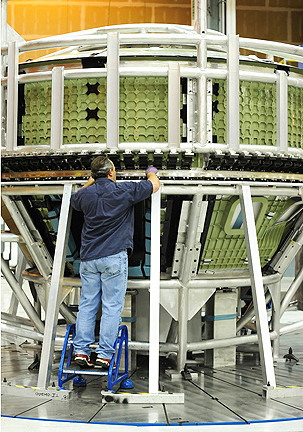
Lockheed Martin weld engineer Troy Alexander inspects the clamps on the tool in preparation for the final weld on the Orion spacecraft. The vehicle was inverted in the tool for this weld. Nondestructive evaluations will validate the strength and integrity of the weld before the spacecraft is prepped for testing in flight-like environments, including static vibration, acoustics and water landing tests. Photo is courtesy of Lockheed Martin
The completion of the crew module welds marked another key milestone for the Orion crew exploration vehicle, completing the structural framework of the spacecraft. All welds have met stringent quality requirements without any rework required. Prior to flight testing, this crew module will be tested on the ground in flight-like environments, including static vibration, acoustic, and water landing tests. Results will be used to correlate sizing models for all subsystems on the vehicle.
Orion weld operations take place on a Universal Weld System II (UWS II) that includes a 22-foot diameter turntable, a self-reacting friction stir weld head and a modular t-grid floor. The system affords virtually unlimited five-axis welding on fixture-mounted hardware. The UWS II is part of the National Center for Advanced Manufacturing, managed by the University of New Orleans Foundation in partnership with NASA and the State of Louisiana. The friction stir welding process advances the state-of-the-art for circumferential welds, yielding higher strength and higher quality welds at a lower cost. The latest state-of-the-art manufacturing technologies, efficient processes and new materials, such as the ultra-light weight Aluminum-Lithium alloy, are all being employed on Orion to produce the lightest possible vehicle for space flight.
Lockheed Martin is the prime contractor to NASA for the Orion crew exploration vehicle — the nation’s next generation spacecraft for future exploration throughout our solar system. The Orion spacecraft is comprised of a crew module for crew and cargo transport; a service module for propulsion, electrical power and fluids storage; a spacecraft adapter for securing it to the launch vehicle, and a launch abort system that will significantly improve crew safety.