

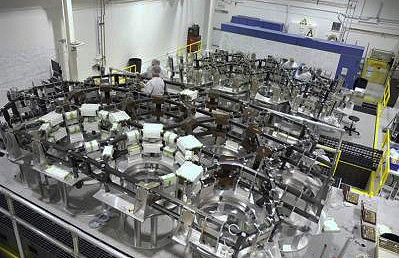
James Webb Space Telescope pathfinder backplane manufacture photo
The James Webb Space Telescope reached another key milestone with the delivery of the pathfinder backplane to Northrop Grumman (NYSE:NOC), prime contractor on the program. Like so much of the hardware on this unique spacecraft, the backplane, built by Alliant Techsystems (NYSE:ATK) is being manufactured to demanding specifications that will allow the telescope to perform its mission in the harsh environment 1 million miles from Earth. The backplane must support the weight of the telescope's beryllium mirrors, instruments, and other elements during launch and hold the 18-segment, 21-foot-diameter primary mirror nearly motionless while the telescope is peering into deep space. The backplane meets exacting thermal stability requirements. For example, it must not deform more than 38 nanometers (about 1/10,000 the diameter of a human hair) while the telescope is operating, even though it will experience temperatures colder than -400 degrees Fahrenheit.
The pathfinder backplane is a full-scale engineering model of the flight backplane and will be used to demonstrate integration and test procedures prior to implementing them on the flight telescope. Consisting of 2,540 parts, the backplane is built with advanced, lightweight graphite composite material attached to metallic fittings. The pathfinder is a high-fidelity model of the Optical Telescope Element, which is the eye of the observatory. A full-size structure, it consists of 12 of the 18 hexagonal cells (the center section) of the telescope and contains a subset of two primary mirror segment assemblies, the secondary mirror and aft optics subsystem. The pathfinder is made of the same material with the same tolerances as the flight backplane, which measures 24 by 21 by 9 feet to accommodate interfaces at the top and bottom.
Used by NASA and the entire Webb telescope team, the pathfinder supports numerous engineering models and flight optics. In addition to demonstrating integration and alignment techniques, it will be subjected to optical performance measurements at cryogenic temperatures and will verify all ground support equipment and test procedures. The James Webb Space Telescope is the world's next-generation space observatory and successor to the Hubble Space Telescope. The most powerful space telescope ever built, Webb will observe the most distant objects in the universe, provide images of the very first galaxies ever formed and see unexplored planets around distant stars. The Webb telescope is a joint project of NASA, the European Space Agency and the Canadian Space Agency.