

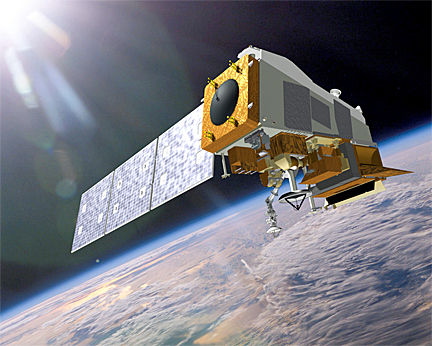
Artistic rendition of the Suomi-NPP satellite, courtesy of NOAA.
At a ceremony at the European Union (EU) Delegation in Washington, D.C. yesterday, Kathryn D. Sullivan, Ph.D., NOAA acting administrator and Alain Ratier, EUMETSAT’s director general, signed the agreement. They were joined by Dr. Francois Rivasseau, deputy chief of mission, EU Delegation to the United States.
“The need for environmental intelligence has never been stronger. This partnership with our EUMETSAT colleagues allows us to continue collecting and sharing vital space-based observations, resulting in a better understanding of our global environment,” Sullivan said.
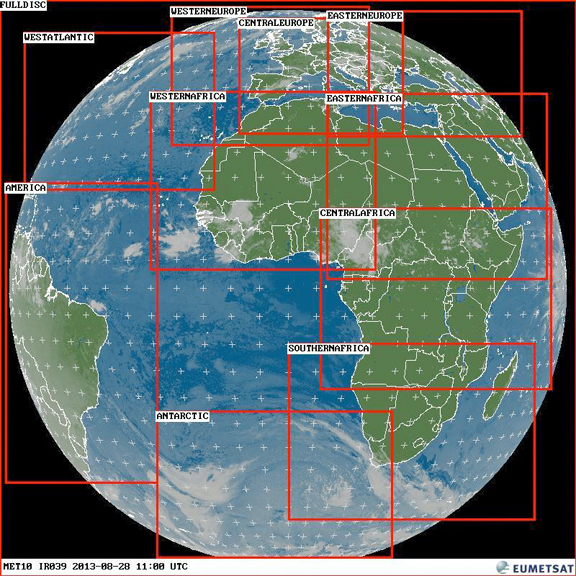
METEOSAT image, captured on August 28, 2013—courtesy of NOAA.
Key successes of the NOAA-EUMETSAT partnership include...
- NOAA and EUMETSAT operate a joint polar satellite system, where EUMETSAT’s Metop satellites fly in the mid-morning orbit, while NOAA’s polar satellites and the Suomi NPP spacecraft fly in the afternoon orbit. Both agencies share all the data, which form the backbone of all medium range weather forecasts in the United States and Europe and make up the majority of the data used by the U.S. weather model (GFS) and the major European weather model (ECMWF)
- NOAA instruments fly onboard the EUMETSAT satellites, and EUMETSAT instruments are on the NOAA spacecraft, providing cost savings and more uniform datasets for meteorologists and scientists across continents
- NOAA and EUMETSAT also exchange data from geostationary satellites, and have a back-up agreement in place for data sharing should either agency’s spacecraft experience trouble
- The partnership also extends to the Jason-2 ocean surface topography mission that has been crucial to improvements in weather modeling and tropical storm intensification forecasting, and is supporting the EU-led Copernicus Earth Observation program with data from the Suomi NPP satellite
NOAA’s mission is to understand and predict changes in the Earth's environment, from the depths of the ocean to the surface of the sun, and to conserve and manage our coastal and marine resources.