

The Company, considered a startup, anticipates the cost to be several billion dollars for LightSquared investors. The group appears limited to LightSquared owner Harbinger Capital Partners, a New York hedge fund that is seeking other partners.
The satellite is a relatively small portion of that investment, and is likely to account for an even smaller amount of LightSquared revenue. But to retain its U.S. Federal Communications Commission license, LightSquared must maintain a functional satellite service even if space-based communications appears only denoted in the company’s future financial statements.
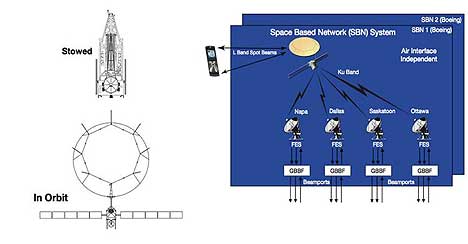
SkyTerra 1 was built by Boeing Space and Intelligence Systems of El Segundo, California. Its 22-meter-diameter L-band antenna, built by Harris Corp. of Melbourne, Florida, is the largest-diameter antenna ever launched on a commercial satellite, even if much of the technology is based on work originally done on U.S. military communications spacecraft.
Boeing began deploying the antenna November 30 but quickly encountered a glitch that industry officials said is of unclear origin. Boeing has declined comment on the problem beyond saying the antenna’s deployment has been delayed. Once the problem was discovered, Boeing said, the company assembled a team to assess what maneuvers could be performed to correct the problem.
The exact procedure used by Boeing, with the aid of Harris, to unblock the deployment remains unclear. But two industry officials said that with a 98 percent deployment, the antenna is all but certain to provide the power and coverage that LightSquared needs to meet its regulatory obligations. One official said that if the antenna’s ribbing does not lock into place, there is a risk of less-than-optimal coverage. But this official said the risk was not large, and that it now appeared clear that LightSquared would be able to use the satellite as designed. Boeing officials declined to comment on the situation beyond saying they were working on the deployment.