

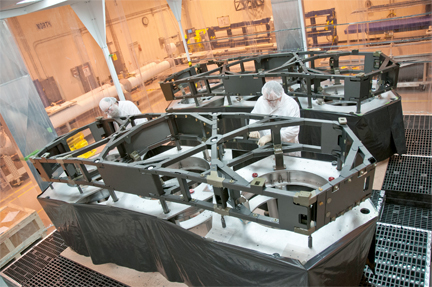
Technicians complete the primary mirror backplane support structure wing assemblies for NASA's James Webb Space Telescope at ATK's Space Components facility in Magna, Utah. Photo courtesy of ATK.
...fabrication of the primary mirror backplane support structure (PMBSS) wing assemblies for NASA's James Webb Space Telescope. Northrop Grumman is under contract to NASA's Goddard Space Flight Center in Greenbelt, Maryland, for the design and development of the Webb Telescope's optics, sunshield and spacecraft. The primary mirror backplane supports the telescope's beryllium mirrors, instruments and other elements during ground test operations and launch. It holds the 18-segment, 21-foot-diameter primary mirror nearly motionless while the telescope is peering into deep space. The deployable wing sections complete the backplane structure while providing thermal stability. Their unique folding design permits the telescope to fit in the five-meter fairing of the launch vehicle.
Measuring approximately 24 by 21 feet, and weighing more than 2,000 pounds, the primary mirror backplane support structure—which includes the wing assemblies as well as the center section that ATK completed in February 2012—must meet unprecedented thermal stability requirements. While the telescope is operating at a range of extremely cold temperatures, from -406 to -343 degrees Fahrenheit, the backplane must not vary more than 38 nanometers (approximately 1/1,000 the diameter of a human hair). For reference, if the mirror were enlarged to span from Los Angeles to New York City, the tolerance for error would be less than 1 inch.
The wing assemblies of the Webb Telescope's primary mirror backplane support structure were designed and fabricated and will be tested at ATK facilities in Magna, Utah. ATK designed and built the 900 composite parts of the wing assembly using lightweight graphite materials and advanced fabrication techniques. The composite parts attach to precision metallic fittings that provide interfaces with the other elements of the observatory.
The James Webb Space Telescope is the world's next-generation space observatory and successor to the Hubble Space Telescope. The most powerful space telescope ever built, the Webb Telescope will observe the most distant objects in the universe, provide images of the first galaxies formed and see unexplored planets around distant stars. The Webb Telescope is a joint project of NASA, the European Space Agency and the Canadian Space Agency.