

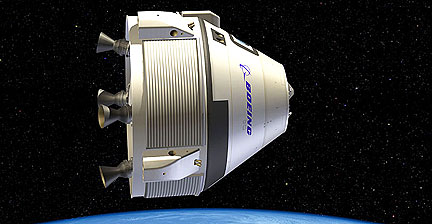
A mock-up of Boeing's Crew Space Transportation (CST)-100 spacecraft and a pressurized structure of the crew module was on display at the Boeing exhibit at the 27th National Space Symposium in Colorado Springs, Colo, last week. The Crew Space Transportation (CST)-100 can carry a crew of seven and will be used to support the International Space Station and Bigelow Orbital Space Complex.
Boeing [NYSE: BA] has been selected for the second round of NASA’s Commercial Crew Development (CCDev) program. Under a $92.3 million CCDev-2 contract, the company will further mitigate program risk and mature the system design of its Crew Space Transportation (CST)-100 spacecraft, which is comprised of a crew module and a service module and relies on proven materials and subsystem technologies that are safe and affordable. Boeing also plans to supply the CST-100 to Bigelow Aerospace for that company’s space station. The CST-100 is designed to carry up to seven people, or a combination of people and cargo, and is compatible with a variety of expendable launch vehicles.
Under the initial CCDev Space Act Agreement of 2010, Boeing successfully completed several risk reduction demonstrations and a System Definition Review (SDR) in October, with only $18 million in government investment. The SDR defined the CST-100 spacecraft’s system characteristics and configuration and established a baseline design. Among the many accomplishments Boeing achieved during this first phase of the CCDev program were the design, build and testing of a pressurized structure of the crew module and an avionics systems integration facility to support rapid prototyping and full-scale development.
NASA’s new 14-month CCDev-2 Space Act Agreement builds on the work performed during the first round of CCDev and enables Boeing to further mature its system to a Preliminary Design Review, a critical step that ensures the system design meets all requirements. Boeing also will conduct key demonstrations and development tests. The company plans to gather performance data on the launch abort system and the service module fuel tank; evaluate vehicle ascent performance in wind tunnel testing; and build on earlier landing air bag and parachute demonstrations with more in-depth investigations. Most of the work will be located at Boeing sites at Kennedy Space Center, Fla.; Houston; Huntington Beach, Calif.; and Huntsville, Ala. Key suppliers include Bigelow Aerospace, Pratt & Whitney Rocketdyne, Airborne Systems, ILC Dover, Spincraft, United Space Alliance and the ARES Corporation. Boeing's Commercial Crew Transportation System includes the CST-100 spacecraft, launch services and ground systems — all integrated to support a safe and reliable operations concept. Using expertise and resources from across the Boeing enterprise provides a complete end-to-end transportation service to support NASA crew transportation to and from the International Space Station.