

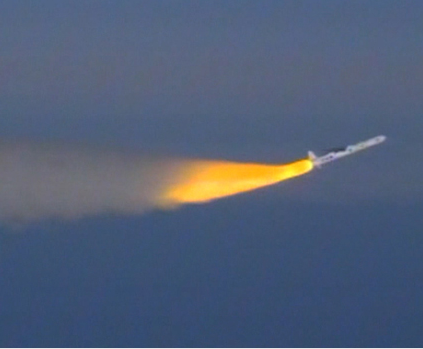
The Pegasus rocket ignites to send NASA's IRIS spacecraft into orbit. Photo credit: NASA TV.
Orbital Sciences Corporation (NYSE: ORB) announced today that its Pegasus® rocket successfully launched the Interface Region Imaging Spectrograph (IRIS) satellite for the National Aeronautics and Space Administration (NASA). The IRIS spacecraft was deployed into its targeted orbit approximately 400 miles above the Earth and early results confirm that the satellite is operating as anticipated at this stage of its mission.
The launch of the Pegasus rocket originated from Vandenberg Air Force Base (VAFB), California when Orbital’s’ L-1011 “Stargazer” carrier aircraft took off from the airfield at approximately 6:30 p.m. (PDT). Following a one-hour preplanned positioning flight, the Pegasus rocket was released at approximately 40,000 feet from Orbital’s L-1011 “Stargazer” carrier aircraft at 7:27 p.m. (PDT). After a 13-minute powered flight sequence, Pegasus launched the 440-pound IRIS satellite into its polar, sun-synchronous Earth orbit.
“The Pegasus rocket carried out another successful mission for NASA today, extending its record of consecutive successful missions to 28 over a 16-year period,” said Mr. Ron Grabe, Orbital’s Executive Vice President and General Manager of its Launch Systems Group. “We are proud of our launch team and are pleased to have contributed to a successful beginning of this important NASA heliophysics science mission.”
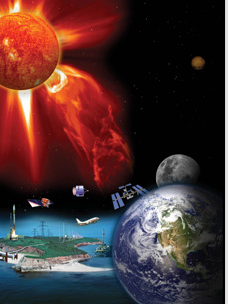
The Study of the Sun and its Interaction with Earth and the Solar System is called Heliophysics.
"We are thrilled to add IRIS to the suite of NASA missions studying the sun," said John Grunsfeld, NASA's associate administrator for science in Washington. "IRIS will help scientists understand the mysterious and energetic interface between the surface and corona of the sun."
"Congratulations to the entire team on the successful development and deployment of the IRIS mission," said IRIS project manager Gary Kushner of the Lockheed Martin Solar and Atmospheric Laboratory in Palo Alto, California. "Now that IRIS is in orbit, we can begin our 30-day engineering checkout followed by a 30-day science checkout and calibration period."
IRIS is expected to start science observations upon completion of its 60-day commissioning phase. During this phase the team will check image quality and perform calibrations and other tests to ensure a successful mission.
NASA's Explorer Program at Goddard Space Flight Center in Greenbelt, Md., provides overall management of the IRIS mission. The principal investigator institution is Lockheed Martin Space Systems Advanced Technology Center. NASA's Ames Research Center will perform ground commanding and flight operations and receive science data and spacecraft telemetry.
The Smithsonian Astrophysical Observatory designed the IRIS telescope. The Norwegian Space Centre and NASA's Near Earth Network provide the ground stations using antennas at Svalbard, Norway; Fairbanks, Alaska; McMurdo, Antarctica; and Wallops Island, Va. NASA's Launch Services Program at the agency's Kennedy Space Center in Florida is responsible for the launch service procurement, including managing the launch and countdown. Orbital Sciences Corporation provided the L-1011 aircraft and Pegasus XL launch system.
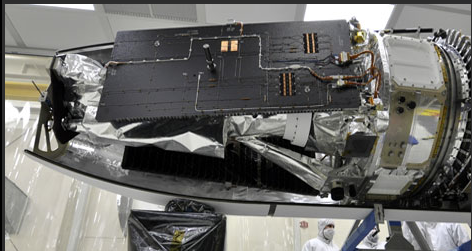
IRIS to Take Precise Look at Sun's Energy NASA's IRIS spacecraft will use an ultraviolet telescope to look at a small area of the sun to answer detailed questions.
IRIS is a NASA Explorer Mission to observe how solar material moves, gathers energy and heats up as it travels through a little-understood region in the sun's lower atmosphere. This interface region between the sun's photosphere and corona powers its dynamic million-degree atmosphere and drives the solar wind. The interface region also is where most of the sun's ultraviolet emission is generated. These emissions impact the near-Earth space environment and Earth's climate.
The Pegasus XL carrying IRIS was deployed from an Orbital L-1011 carrier aircraft over the Pacific Ocean at an altitude of 39,000 feet, off the central coast of California about 100 miles northwest of Vandenberg. The rocket placed IRIS into a sun-synchronous polar orbit that will allow it to make almost continuous solar observations during its two-year mission.
The launch of IRIS marks the 45th overall mission for the Pegasus program. Its launch history now includes 42 launches to orbit, which collectively have deployed more than 80 satellites for Earth and space science missions overseen by NASA; military and technology demonstration spacecraft for the U.S. Department of Defense; and communications and imaging satellites for commercial customers. Pegasus technology has also been used to launch three hypersonic flight experiments in Earth’s stratosphere for NASA’s HyperX program.
IRIS is a NASA Small Explorer (SMEX) mission designed to observe how solar material moves, gathers energy and heats up as it travels through a little-understood region in the Sun’s lower atmosphere. This interface region between the Sun’s photosphere and corona powers its dynamic million-degree atmosphere and drives the solar wind. The interface region also is where most of the Sun’s ultraviolet emission is generated that impacts the near-Earth space environment and Earth’s climate.
IRIS is expected to start science observations upon completion of its 60-day commissioning phase. During this phase the team will check image quality and perform calibrations and other tests to ensure a successful mission.
Pegasus provides launch systems for the deployment of small satellites into low-Earth orbit. Its patented air-launch system, in which the rocket is launched from beneath Orbital’s “Stargazer” L-1011 carrier aircraft over the ocean, reduces cost and provides customers with unparalleled flexibility to operate from virtually anywhere on Earth with minimal ground support requirements. It is the world’s only small space launch vehicle that is certified with NASA’s Payload Risk Category 3, which the space agency reserves for its highest value space missions. Past Pegasus flights have originated from six launch sites around the globe.
Orbital develops and manufactures small- and medium-class rockets and space systems for commercial, military and civil government customers. The company’s primary products are satellites and launch vehicles, including low-Earth orbit, geosynchronous-Earth orbit and planetary spacecraft for communications, remote sensing, scientific and defense missions; human-rated space systems for Earth-orbit, lunar and other missions; ground- and air-launched rockets that deliver satellites into orbit; and missile defense systems that are used as interceptor and target vehicles. Orbital also provides satellite subsystems and space-related technical services to government agencies and laboratories.
NASA's Explorer Program at Goddard Space Flight Center in Greenbelt, Maryland, provides overall management of the IRIS mission. The principal investigator institution is Lockheed Martin Space Systems Advanced Technology Center. NASA's Ames Research Center will perform ground commanding and flight operations and receive science data and spacecraft telemetry.