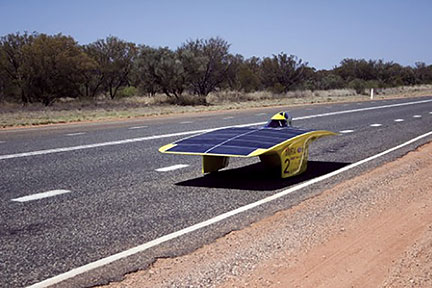
 The University of Michigan's solar car going through its paces. Photo courtesy of the University of Michigan.
For their journey across the Outback, the University of Michigan team will be equipped with three Cobham Explorer 300 BGAN terminals provided by Satcom Direct and 25 GB of data allowance from Inmarsat. During the race, the team will use the BGAN service to share information on weather forecasting, road conditions, potential hazards along the race route and details on the performance of the vehicle. BGAN will also enable the team to post images and videos and post on social media sites to keep fans and sponsors up-to-date on progress.
“Reliable communications is a vital part of the World Solar Challenge and with Inmarsat’s BGAN network we have the advantage of having real time knowledge of conditions that might affect performance,” said Jeffrey Cwaganberg, Director of Meteorology, University of Michigan Solar Car Team. “We are grateful to Inmarsat for their support.”
Recognizing the importance of harnessing solar power as an alternative means of energy, Inmarsat has taken an active role in supporting the World Solar Challenge by providing communications support to other entrants. Together with manufacturing partner Cobham, Inmarsat is outfitting Netherland’s based Team Twente with mobile satellite connectivity for their car, The RED Engine. Additionally, Inmarsat partner JSAT Mobile Communications is working with Addvalue Technologies to sponsor the Solar Car Project Team from Kogakuin University in Japan.
Topical Tags :
Regional Tags :


 [SatNews] This company is now sponsoring the University of Michigan’s World Solar Car Team, as they race across Australia this October in the World Solar Challenge.