

Hubble Ultra Deep Field Infrared — Hubble Space Telescope
The deeper Hubble looks into space, the farther back in time it looks, because light takes billions of years to cross the observable Universe. This makes Hubble a powerful "time machine" that allows astronomers to see galaxies as they were 13 billion years ago.
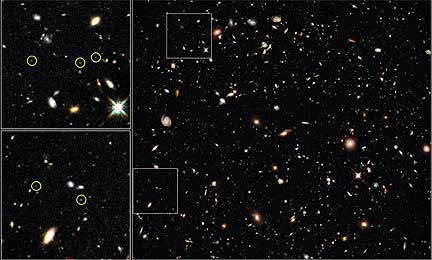
"With the rejuvenated Hubble and its new instruments, we are now entering unchartered territory that is ripe for new discoveries," says Garth Illingworth of the University of California, Santa Cruz, leader of the survey team that was awarded the time to take the new WFC3 infrared data on the Hubble Ultra Deep Field (imaged in visible light by the Advanced Camera for Surveys in 2004). "The deepest-ever near-infrared view of the Universe — the HUDF09 image — has now been combined with the deepest-ever optical image — the original HUDF (taken in 2004) — to push back the frontiers of the searches for the first galaxies and to explore their nature," Illingworth says.
Ross McLure of the Institute for Astronomy at Edinburgh University and his team detected 29 galaxy candidates, of which twelve lie beyond redshift 6.3 and four lie beyond redshift 7 (where the redshifts correspond to 890 million years and 780 million years after the Big Bang respectively). He notes that "the unique infrared sensitivity of Wide Field Camera 3 means that these are the best images yet for providing detailed information about the first galaxies as they formed in the early Universe".
James Dunlop of the University of Edinburgh agrees. "These galaxies could have roots stretching into an earlier population of stars. There must be a substantial component of galaxies beyond Hubble's detection limit."
Three teams worked hard to find these new galaxies, announced in a burst of papers immediately after the data were released in September, and were soon joined by a fourth team, and later a fifth. A total of 15 papers have been submitted to date by astronomers worldwide. To view more photos and learn more visit.