

Space Systems/Loral (SSL), provider of commercial satellites, today announced that the Amazonas 3 multi-mission satellite, designed and built for HISPASAT Group, was launched last Thursday and is successfully performing post-launch maneuvers according to plan. The satellite deployed its solar arrays on schedule following its launch aboard an Ariane 5 launch vehicle provided by Arianespace from the European Spaceport in Kourou, French Guiana. The satellite has begun firing its main thruster to complete its journey to geostationary orbit.
“It has been a privilege to work closely with our colleagues at HISPASAT and to see the successful launch of this important satellite,” said John Celli, president of SSL. “I would like to thank everyone at HISPASAT, Arianespace, and SSL for their hard work and dedication to making this satellite program a success.”

Amazonas 3 is a multi-mission satellite that includes the first Ka-band payload for broadband service in Latin America. It will provide a wide range of telecommunications services including direct-to-home television (DTH), corporate fixed and mobile telephone networks, and broadband in the Americas, Europe, and North Africa. The satellite, which will be positioned at 61 degrees West longitude, has 33 Ku-band and 19 C-band transponders, and nine Ka-band spot beams.
“We are very pleased with SSL’s strong execution on the satellite program and early delivery of Amazonas 3,” said Carlos Espinós, chief executive officer of HISPASAT. “Once in service, it will help us expand our services and meet the growing demand for telecommunications services around the world.”
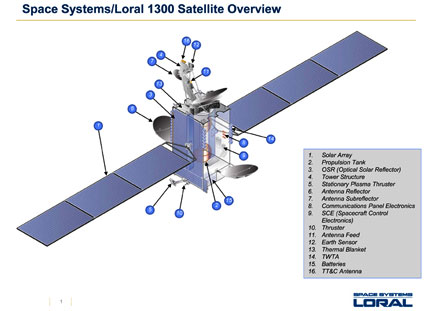
The satellite is based on the highly reliable SSL 1300 space-proven platform, (learn more here) which provides the flexibility to support a broad range of applications and technology advances. The spacecraft is designed to deliver service for 15 years or more. With this launch, there are 71 SSL-built satellites currently on orbit.