

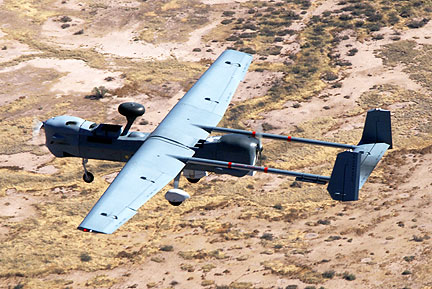
A U.S. Army MQ-5B Hunter performs a training mission near Sierra Vista, Ariz. Photo courtesy of Northrop Grumman.
The MQ-5B Hunter is distinguished by its heavy fuel engines, its "wet" (fuel-carrying) extended center wing with weapons-capable hard points and a modern avionics suite. The MQ-5B Hunter system uses the Army's One System ground control station and remote video terminal. It also carries a communications relay package to extend the radio range of warfighters. A differential GPS automatic takeoff and landing system is under development for Hunter. The MQ-5B features a robust, fixed-wing, twin tail-boom design with redundant control systems powered by two heavy fuel engines – one engine to "push" and another to "pull" the air vehicle. Another Hunter capability is its relay mode that allows one Hunter to be controlled by another UAV at extended ranges or over terrain obstacles typical of those found in the Balkans and Afghanistan.
To replace obsolete systems, increase readiness and reduce the logistics burden on soldiers, Northrop Grumman integrated a new suite of avionics for Hunter, including upgraded flight and mission computers, an auxiliary power distribution unit, the LN-251 inertial navigation system with GPS, a downsized data link system and an APX-118 Identification Friend or Foe transponder. The avionics suite improves performance by reducing size, weight and power consumption of the equipment used to control the aircraft and manage its critical subsystems.