

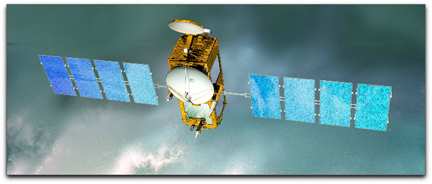
 Thales Alenia Space has signed with French Space Agency (CNES) and now has the contract to build the Jason-3 satellite. The Jason-3 operational oceanographic mission involves a quadripartite collaboration between the two meteorological organizations Eumetsat and NOAA, acting as the leaders of the program, and CNES and its American counterpart NASA.
Jason-3 will allow the continuity of high precision ocean topography measurements beyond TOPEX/Poseidon, Jason-1 and Jason-2, which are now operational in orbit. It will also provide a bridge to an operational mission to enable the continuation of multi-decadal ocean topography measurements. Jason 3 will offer the same ocean measurement accuracy as Jason 2, including near coastal zones, as well as lakes and rivers. Based on the Proteus platform, Jason-3 features the Poseidon-3B altimeter, also developed by Thales Alenia Space in Toulouse. The Poseidon-3B dual-frequency altimeter continues to be the key instrument in this spaceborne observation program. Included in the core mission, Jason-3 will embark the DORIS precise orbit determination system, an Advanced Microwave Radiometer (AMR), a GPS payload (GPSP), and a Laser Retro-reflector Array (LRA).
The satellite will be placed in the same orbit as Jason-2, at an altitude of 1,336 kilometres with an inclination of 66 degrees, to provide virtually blanket coverage of all ice-free ocean surfaces. Its weight at launch is 553 kilogrammes, with 550 W of power and pointing accuracy of 0.15° (half-cone). Its launch is expected for mid 2013 for a mission life of 3 years. The Soil Moisture and Ocean Salinity (SMOS) mission, built by Thales Alenia Space and launched in November 2009, will provide regular maps of sea surface salinity, showing where and when large amounts of fresh waters are introduced in the cycle, for instance through rains, about 90 percent of which are estimated to fall over open sea. To complete the global understanding of the water cycle, CryoSat, will feature a unique instrument, the Siral interferometry radar altimeter that will monitor the thickness of sea ice and ice shelf’s. Through GMES and the Sentinel satellites program, Thales Alenia Space is already working on the next generation of satellites that will continue monitoring the water cycle at a global scale. For more than 20 years, Thales Alenia Space has been in the forefront of efforts to meet major environmental challenges, whether meteorological or oceanographic. The company is also a worldwide leader in high-performance optical and radar payloads, for civil and military use.