

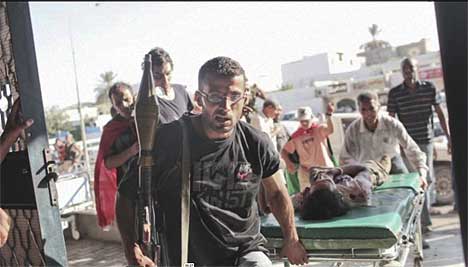
New York Times, TimesCast, Fighting For Tripoli
After seven months' intense activity treating the injured from Tripoli and the western region of Libya, medical organizations from the Djebel Nafusa region have, with the backing of TSF, been able to improve their daily work. The day of their arrival in this region, on 25th August, TSF installed a mobile satellite connection (using BGAN) in the hospital at Jadu, designed to be used by hospital personnel and medical NGOs on site, of which the NGO IMC (International Medical Corps). TSF has reinforced the connection by setting up a VSAT terminal (fixed satellite solution) on September 6th.
This is the most important hospital in the region. The support of TSF was solicited by the medical establishment for the opening of this Broadband connection. For Doctor Isam Athanis, from the hospital at Jadu, TSF connections have improved the exchange of information and the work of the medical teams. "We spent six months without Internet connection. Thanks to TSF, the Internet connection at the hospital in Jadu allows us to contact Tripoli to get supplies and ask advice from other doctors in England. It really is a relief for all the doctors here to be connected and able to ask for help if needed."
For Doctor Walid, the TSF connection has radically changed the situation: “Before its opening, the nearest Internet connection was located in Tripoli. I can now send emails or use skype to discuss patients with other cities in Libya. Also I’m using the connection to send medical samples and pictures to other countries, such as England and Italy, and have the opinion of world specialists.”
Since the month of April, the team of TSF ICT specialists has installed broadband Internet satellite connections in Benghazi, Misrata, then in different cities in the Djebel Nafusa region (Nalut, Jadu and Yefren), to the benefit of the international NGOs and the medical establishments in charge of treating the injured from the western region of the country.
The total number of strategic coordination centers connected by TSF is today six: four in the Djebel Nafusa region (in Nalut, Yefren and Jadu) and two in Misrata and Benghazi.
Our teams are very mobile and they frequently move all over the region, making the journey from Yefren to Nalut several times a week. In this unstable political context, the objective for TSF is to provide the most effective and largest response to the telecoms needs. TSF provides tech support to humanitarian workers, fixing and setting up their telecom and computer equipment when requested.
Those journeys are dangerous as security still remains a major problem in the western region of the country, and conflicts still persist between Yefren and Tripoli (Gharyan, Kikla and Qawasim).
The support TSF provides is crucial as Emma, working for the NGO IMC in Zintan, confirms: “In an hour you fixed our Internet connection in the office. Thanks TSF for your help, it will save us a lot of time in helping people."
These connections optimize the exchange of crucial information between the emergency responders on the ground, strengthening their capacities in aiding the affected populations. In particular, they reinforce the capacities of the hospitals and the Libyan Red Cross. As well as the humanitarian support provided by TSF, in particular in the medical field, TSF’s connections promote and support the local culture and identity.
They enable information that was forbidden to be sent.
At Yefren media center, the local press now can publish a local newspaper on the town’s local activities and associations, as Akram B-Ashour, a volunteer at Yefren’s media center, describes: "Before the revolution we were not allowed to speak Tamazight. Now, thanks to TSF we can promote our culture again. We are now working on the first global meeting for Tamazight's culture in Libya's history."
As a reminder: —In Yefren On August 25th, TSF established a fixed satellite connection (VSAT) in the hospital at Yefren. The connection benefits personnel of the establishment and is also available to medical NGOs- Doctors Without Borders is notably based in Yefren.
Equally, the town “media centre”, which is open to the entire humanitarian community, is connected to the VSAT.
— In Nalut
TSF has installed a fixed connection (using KA-SAT) in the Libyan Red Cross offices in Nalut; a connection established for use by the humanitarian community as a whole.
Télécoms Sans Frontières is the leading humanitarian NGO specialized in emergency telecommunications. With its 24-hour monitoring centre and relying on its operational bases in Europe, Central America and Asia, Télécoms Sans Frontières (TSF) crews of IT and telecoms specialists can intervene anywhere in the world in less than 24 hours. After a sudden onset disaster or conflict, they can set up in a matter of minutes a satellite-based telecoms centre offering broadband Internet, phone and fax lines. These centres enable emergency NGOs, the United Nations and local authorities to communicate right at the heart of a crisis. They also facilitate the coordination of aid efforts. In parallel, TSF runs humanitarian calling operation to offer support and assistance to affected civilians, giving them a link with the outside world from which they would be otherwise completely cut off.