


SDO First Light Image — A full-disk multiwavelength extreme ultraviolet image of the sun taken by SDO on March 30, 2010. False colors trace different gas temperatures. Reds are relatively cool (about 60,000 Kelvin, or 107,540 F); blues and greens are hotter (greater than 1 million Kelvin, or 1,799,540 F). Credit: NASA
The spacecraft also has made the first high-resolution measurements of solar flares in a broad range of extreme ultraviolet wavelengths. Launched on February 11, 2010, SDO is the most advanced spacecraft ever designed to study the sun. During its five-year mission, it will examine the sun's magnetic field and also provide a better understanding of the role the sun plays in Earth's atmospheric chemistry and climate. Since launch, engineers have been conducting testing and verification of the spacecraft's components. Now fully operational, SDO will provide images with clarity 10 times better than HD television and will return more comprehensive science data faster than any other solar observing spacecraft.
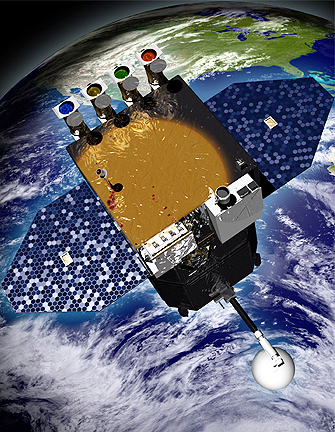 SDO will send 1.5 terabytes of data back to Earth each day, which is equivalent to a daily download of half a million songs onto an MP3 player. The observatory carries three state-of the-art
instruments for conducting solar research. The Helioseismic and Magnetic Imager maps solar magnetic fields and looks beneath the sun's opaque surface. The experiment will decipher the physics of the sun's activity, taking pictures in several very narrow bands of visible light. Scientists will be able to make ultrasound images of the sun and study active regions in a way similar to watching sand shift in a desert dune. The instrument's principal investigator is Phil Scherrer of Stanford University. HMI was built by a collaboration of Stanford University and the Lockheed
Martin Solar and Astrophysics Laboratory in Palo Alto, California.
SDO will send 1.5 terabytes of data back to Earth each day, which is equivalent to a daily download of half a million songs onto an MP3 player. The observatory carries three state-of the-art
instruments for conducting solar research. The Helioseismic and Magnetic Imager maps solar magnetic fields and looks beneath the sun's opaque surface. The experiment will decipher the physics of the sun's activity, taking pictures in several very narrow bands of visible light. Scientists will be able to make ultrasound images of the sun and study active regions in a way similar to watching sand shift in a desert dune. The instrument's principal investigator is Phil Scherrer of Stanford University. HMI was built by a collaboration of Stanford University and the Lockheed
Martin Solar and Astrophysics Laboratory in Palo Alto, California.