

Photo courtesy of Lockheed Martin
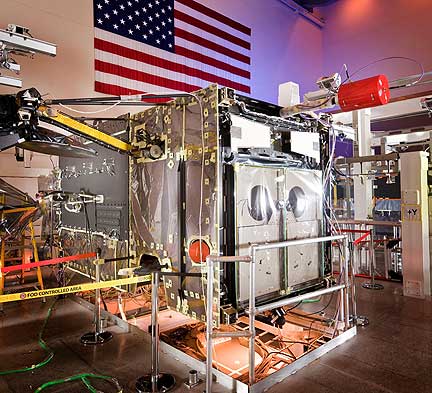
The milestone, known as the 5001.4 test, verifies the spacecraft’s performance and interface with the ground segment and represents one of the program’s most significant milestones to date on the path to launch. The first SBIRS geosynchronous spacecraft, with its highly sophisticated scanning and staring sensors, will provide the nation with significantly improved missile warning capabilities and support other critical missions simultaneously including missile defense, technical intelligence and battlespace awareness. The successful 5001.4 test demonstrated the capability to transmit data between the spacecraft and flight control facilities, and the ability of the SBIRS GEO-1 integrated ground and space system to perform critical operations.
On the path to delivery, the SBIRS team will perform final spacecraft component installations and conduct a final factory confidence test on GEO-1, as well as complete final updates to ground software and command products. Qualification of the satellite's flight software, designed to provide highly reliable command and control operations, is also progressing steadily, and is on track for completion in February. The SBIRS team is led by the Infrared Space Systems Directorate at the U.S. Air Force Space and Missile Systems Center. Lockheed Martin is the SBIRS prime contractor, with Northrop Grumman, as the payload integrator. Air Force Space Command operates the SBIRS system. Lockheed Martin's original SBIRS contract includes HEO payloads, two geosynchronous orbit (GEO) satellites, as well as ground-based assets to receive and process the infrared data. The team is also under a follow-on production contract to deliver additional HEO payloads and the third and fourth GEO satellites, and associated ground modifications.