

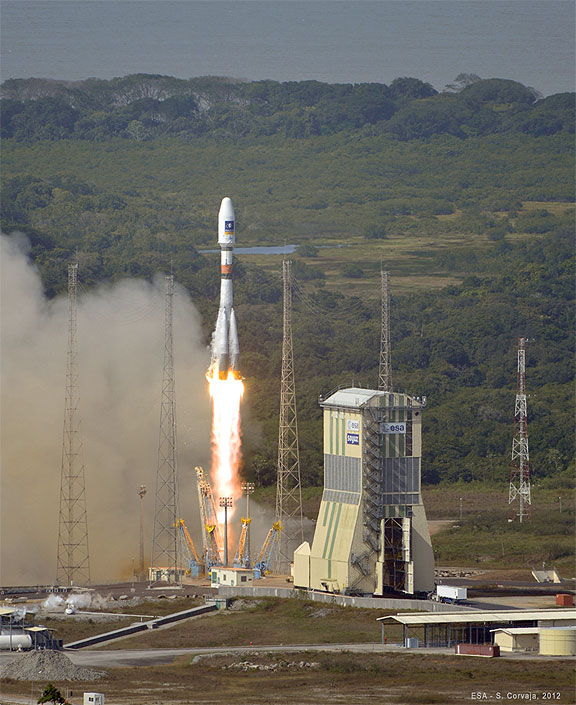
Soyuz begins its ascent from French Guiana with the payload of two Galileo In-Orbit Validation (IOV) satellites.
Photo is courtesy of Arianespace.
...so far in 2012 with its Ariane 5 and Soyuz launchers, successfully orbited two satellites today for the European Galileo navigation network. Lifting off at 3:15:01 p.m. local time, which was the planned precise moment of launch, the Russian-built Soyuz ST vehicle was put through its paces to deploy the pair of Galileo In-Orbit Validation spacecraft during a flight of just under 3 hrs. 45 min. Noting that today’s mission occurred almost exactly one year after Soyuz’ historic first flight from the Spaceport, Arianespace Chairman & CEO Jean-Yves Le Gall said this new success underscored the “exemplary character” of his company’s cooperation with Russia. “In less than one year, three perfect launch successes from the Guiana Space Center have enabled us to demonstrate the operational effectiveness of this new launch system, and to confirm the relevance of our launcher family strategy,” he added.
Good weather offered picture-perfect conditions for the Soyuz liftoff and climb-out from French Guiana, with tracking cameras following the vehicle through its jettison of the four first-stage boosters at almost two minutes into the flight. After the propulsive phases of Soyuz’ second and third stages, the Fregat upper stage took over to perform two burns—separated by a 3-plus-hour ballistic phase—enabling the two 700kg. Galileo satellites to be released in a circular medium-Earth orbit, with an altitude targeted at 23,222km.
This mission is designated VS03 in Arianespace’s launcher family numbering system, and was performed from the purpose-built ELS launch facility for its medium-lift Soyuz, located in the Spaceport’s northern sector near the city of Sinnamary. The pair of Galileo satellites was carried side-by-side on a dual-payload dispenser system, with their release performed in opposite directions by a pyrotechnic separation system that released them at the proper orbital insertion point.
These spacecraft joined the initial two Galileo spacecraft orbited on Arianespace’s milestone VS01 flight on October 21, 2011, which marked Soyuz’ introduction at the Spaceport. Together, the four satellites launched by Arianespace will form an operational mini-constellation—creating the minimum number required to allow navigational fixes for validations of the Galileo system.
An Astrium-led consortium produced the satellites, with assembly and testing performed by Thales Alenia Space. Galileo is a European initiative, with the constellation of navigation spacecraft being developed in a collaborative effort of the European Union and the European Space Agency.
“With our launch last year and the mission today, we have launched these initial four Galileo spacecraft, and beginning next year we will undertake the orbiting of the following 22, using five more Soyuz, along with three Ariane 5 launches,” Le Gall said in post-launch comments at the Spaceport’s mission control center. “This makes Galileo our largest customer.”
Arianespace is keeping up the mission pace in 2012, with this VS03 flight added to five Ariane 5 launches already performed from the Spaceport so far this year, which orbited eight telecommunications satellites, along with an Automated Transfer Vehicle for servicing of the International Space Station. In addition, the Starsem affiliate of Arianespace used a Soyuz ST vehicle from Baikonur Cosmodrome in Kazakhstan to orbit a European weather satellite last month. Complementing this activity was the qualification flight of Arianespace’s lightweight Vega launcher in February, performed under responsibility of the European Space Agency with support from Arianespace.
Arianespace’s next flight is set for November 9th from the Spaceport, employing an Ariane 5 to orbit the EUTELSAT 21B and Star One C3 telecom satellites. While preparations for this mission —designated VA210—are underway, the Ariane 5 for the subsequent VA211 heavy-lift mission was delivered to French Guiana yesterday by the MN Toucan sea-going transport ship.
The announcement of the launch was also prepared by the UK Space Agency and relates that Europe's second pair of fully operational Galileo satellites was successfully launched on October 12, 2012, from the European spaceport in French Guiana, South America.
The satellites’ payloads were designed, manufactured and tested in the UK by Astrium and will be used with the two other satellites launched last year to validate the Galileo system design before becoming part of the final Galileo system. UK company SSTL is building the navigation payloads for the next 22 satellites which will form the operational constellation. Four is the minimum number of satellites needed to achieve a navigational fix on the ground, with one satellite each to measure latitude, longitude, altitude and provide a time reference. Once this second pair of satellites has been commissioned and tested, the quartet will form a completely operational mini-constellation that will be used to validate the Galileo system. These two new satellites are also the first to carry search and rescue antennas to pinpoint aircraft and ships in distress as part of the international Cospas–Sarsat system.
The technologies that the constellation will use have already been demonstrated with two British-built test satellites called GIOVE-A and -B, launched in 2005 and 2008, respectively. GIOVE-A has remained operational long after its expected lifespan and GIOVE-B contains the most reliable timing device ever launched into space.
A joint initiative of the European Commission (EC) and the European Space Agency (ESA), Galileo is the European Union’s answer to the American global satellite navigation system GPS. It is designed to provide a highly accurate global positioning system under civilian control with worldwide coverage and is one of the biggest space projects ever initiated in Europe.
The UK has made a considerable investment in the project and is involved at every level in developing this next generation of satellite navigation technologies. The EC plans for further satellites to be launched every 3 months from spring 2013, until 18 are in orbit and Initial Operational Capability (IOC) is reached around 2015. At this point, initial Galileo services should be certified as ready for use.
At the heart of each Galileo satellite are the atomic clocks which will allow people using receivers, for example, built into smart phones, to know their position to within a metre. These ultra-precise clocks will all beat in rhythm, rigorously synchronized with the ground network of control stations. That is why Galileo has been described as "one vast space clock". Galileo will offer a number of services from 2015 onwards including an open signal, a search and rescue service, a public regulated service for Government approved users and also a prototype commercial service.
The European Commission (EC) estimates that six to seven percent of European GDP—around 800 billion euros by value—is already dependent on satellite navigation currently provided by US GPS or Russian Glonass satellites. The Government is supporting the industry’s ambitious goals for growth in the UK space sector, growing revenues from 7.5bn pounds to 40bn pounds by 2030 and creating 100,000 high-value jobs in the sector. Much of this growth will come from applications based on space services such as Galileo. The Government wants to see Galileo services start as quickly as possible to stimulate the development of new technologies and space-based solutions.