

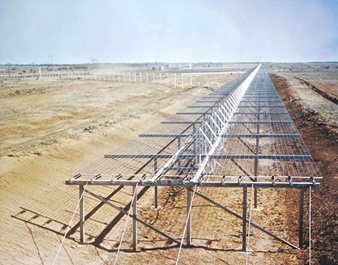
Part of the master transmitter antenna at Lake Kickapoo, Texas c.2001.
The Air Force has awarded Raytheon and Lockheed Martin contracts to provide designs for a space radar system that will be able to detect orbiting objects and debris passing over the United States. So far, each has been obligated $20 million of the potential $107 million contracts, the Air Force said. The space fence project will replace the existing Air Force Space Surveillance System, or VHF Fence. Because it operates on a shorter radar wavelength, the new fence will be able to detect much smaller satellites and debris and thus provide better protection for objects orbiting Earth that pass in close proximity to one another.
The radar system is comprised of three S-band ground-based radars designed to perform automatic detection, tracking, and accurate measurement of space objects orbiting above. Six receiver sites monitor energy reflected from objects that penetrate the narrow, fixed beams the three radar transmitters send out to detect orbiting objects.
The Navy originally was heading up the space fence project but handed it over to the Air Force in 2004. The military expects to spend $3.5 billion on the project, which is expected to be completed in 2015.
The increasing number of satellites and other spacecraft in orbit around Earth has made the need to patrol space more critical and is driving a refurbishment of the existing technology that's doing the job. Incidents such as a collision in February 2009 of a U.S. Iridium communications satellite and a Russian Cosmos 2251 communications satellite demonstrate what can happen if objects passing close to each other aren't detected. Such collisions add even more debris to what already exists in space, exacerbating the situation and providing more threats to satellites and other spacecraft.