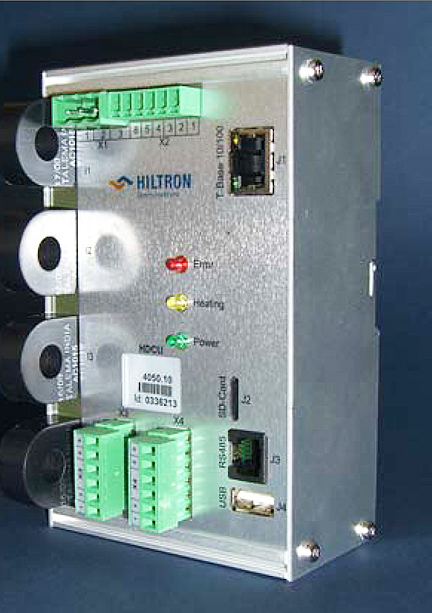
[SatNews] Hiltron Communications, a European provider of satellite and microwave communication equipment and systems, has released a major, new addition to its range of satellite communications control equipment.
Introduced at IBC2010, the Hiltron HDCU-E is a combined ice-sensing and dish-heating system for use with large satellite antennas. It is capable of handling up to 450 kW of heating power assigned across multiple heating groups. Each group is divided into three independently controlled heater arrays. Each array in turn feeds up to three antenna heater circuits. A four-group configuration, for example, allows control of 12 arrays addressing a total of 36 heating circuits. This modular control approach permits easy configuration of parameters such as antenna size, number of heater pads and the power requirement of each pad. Snow detection is via a reflective sensor with a polarising filter. Maintenance, monitoring and control of the HDCU-E are via a standard web browser, allowing easy local or remote supervision. All status messages relating to the heating circuits and the de-icing process are displayed, ensuring easy monitoring and adjustment of individual settings and thresholds. All parameters and status messages can also be controlled via SNMP and web-interface. USB and 100 Mbit/s Ethernet LAN interfaces are provided.
Electric currents levels throughout the HDCU-E are continuously evaluated. Malfunctions such as insufficient or excessive heater pad current, or too high a panel temperature, are automatically detected and displayed. Each heater circuit is individually supervised and controlled via user-adjustable minimum and maximum thresholds. Sequential switch-on is performed within the controller to prevent rapid changes in current load when the antenna heating process is activated or deactivated. Sequence timing is user-configurable. All heating functions can be switched between manual or automatic control. The Hiltron HDCU-E can operate in ambient temperatures of -30 to +50 degrees Celsius and 5 to 95 per cent humidity. Power requirement (three-phase) is 40 kW per group at 400 V AC.