NASA... TIRS Testing (Satellite)
[SatNews] This new instrument will bring in to play technologies to improve upon thermal infrared data collection...
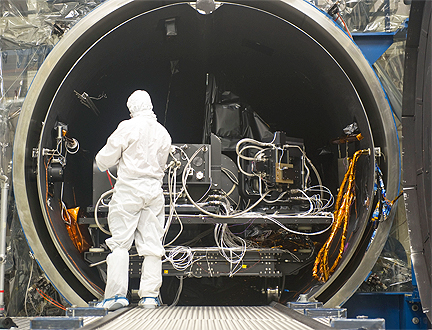 A technician surveys the TIRS instrument and the calibration equipment, preparing to move to the clean room after testing. Credit:NASA/Goddard/Bill Hrybyk
 The two-month test marked the first time engineers evaluated the fully-assembled instrument at its normal operating temperature, a frigid 43 Kelvin (-382° F). The verdict is that
TIRS is living up to its design and even exceeding expectations in some areas. The thermal imager is one of two instruments that will fly on the
Landsat Data Continuity Mission (
LDCM) scheduled to launch in December 2012. A late addition to the mission, TIRS is designed and built in-house at
Goddard. It uses a new detector technology called
Quantum Well Infrared Photodetectors, or
QWIPs, that will continue and improve upon the thermal infrared data collected by the
Thematic Mapper on
Landsat 5 and by the
Enhanced Thermal Mapper-Plus on
Landsat 7, both currently collecting data in orbit.
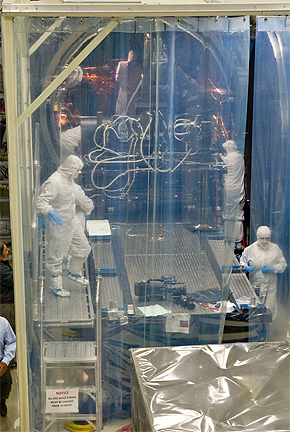 The TIRS instrument sits half out of the thermal vacuum chamber while still protected in a clean tent, as team members disconnect the electrical wires and cooling lines after testing. Credit:NASA/Goddard/Bill Hrybyk
One of the important applications of TIRS will be to help scientists and resource managers monitor water evaporation and transpiration over Earth's land surface by measuring radiation emitted in two thermal bands of the electromagnetic spectrum. TIRS's resolution is 100 meters, which allows monitoring on a field-by-field basis for agriculture. This type of detail is vital for water managers in the semi-arid western U.S. states. Three shifts of engineers manned the testing facility at Goddard 24x7 while TIRS was in the thermal-vacuum test chamber. Inside the blue cylindrical chamber, TIRS viewed targets that provided calibrated thermal illumination for TIRS to sense and sent data to a computer that simulated the spacecraft. The air was pumped out and the temperature in the chamber lowered with liquid nitrogen. Then the instrument's cryocooler was turned on. The cryocooler's job is to maintain a steady 43 K for the three detector arrays even when the chamber temperature goes up and down -- mimicking the temperature changes on the light and dark sides of Earth in space as the satellite orbits our planet.
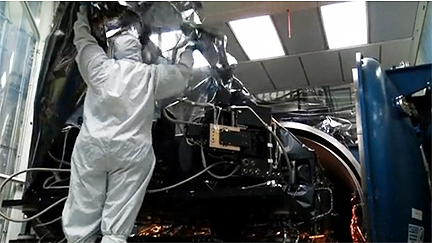 Technicians prepare the TIRS instrument to move to the clean room after testing. Credit: NASA/Goddard
As TIRS heads into environmental testing, including another round in the thermal vacuum chamber, the engineering team is working hard to iron out the kinks to meet their tight delivery deadline. TIRS is scheduled to be on the dock and ready for integration with the
LDCM spacecraft at
Orbital Science Corp. in Gilbert, Ariz. in late January, 2012. The Landsat Program is a series of Earth observing satellite missions jointly managed by
NASA and the
U.S. Geological Survey. Landsat satellites have been consistently gathering data about our planet since 1972. They continue to improve and expand this unparalleled record of Earth's changing landscapes for the benefit of all.

