

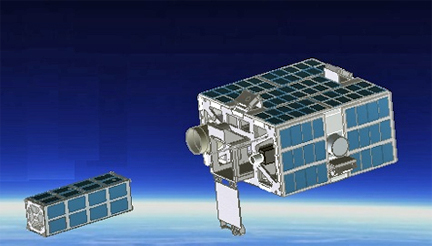
Artistic rendition of Georgia Tech's Prox-1 nanosat.
...the winner of the seventh University Nanosat Program (UNP) competition. Sponsored by the Air Force Office of Scientific Research and the Air Force Research Laboratory, UNP is a two-year competition that culminated with the Flight Competition Review in Albuquerque, New Mexico on January 10-11, 2013.
The Georgia Tech Prox-1 mission is designed to demonstrate automated trajectory control in low-Earth orbit relative to a deployed cubesat. The spacecraft has been designed, fabricated and tested by a team of Georgia Tech undergraduate and graduate students who will also be responsible for mission operations. The Prox-1 spacecraft is equipped with thermal and visible imagers provided by Arizona State University. Prox-1 will deploy a smaller spacecraft, a version of The Planetary Society’s LightSail™ solar sail spacecraft. Prox-1 will fly in close proximity to LightSail, demonstrating automated trajectory control based upon relative orbit determination using passive imaging. Prox-1 will also acquire images of the LightSail solar sail deployment event, and Prox-1 will provide first-time flight validation of advanced sun sensor technology, a small satellite propulsion system, and a lightweight thermal imager.
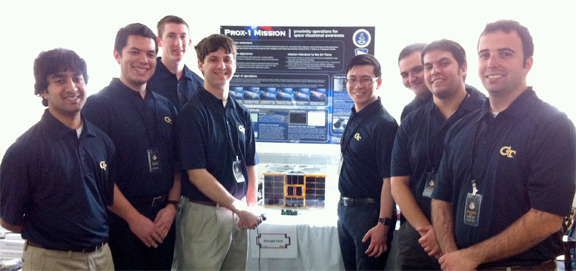
Georgia Tech team members display the Prox-1 spacecraft. From left: Nishant Prasadh, Trevor Siu, Ian McCreadie, Jason Frieman, Kiichiro Deluca, Richard Zappulla, Mike Veto (Arizona State University), Chris Keir.
As the winner of the UNP competition, the Prox-1 mission will receive an Air Force launch slot as a secondary payload, and additional development funding over the next two years. The Prox-1 team will complete spacecraft integration and testing, and work toward a launch in 2015. In addition to support from the U.S. Air Force, the Prox-1 team has been supported through contributions from the Georgia Space Grant Consortium, The Aerospace Corporation, Raytheon Vision Systems, and the Jet Propulsion Laboratory.
(SatNews also thanks Senior Contributing Editor, Jos Heyman, for his contribution.)