

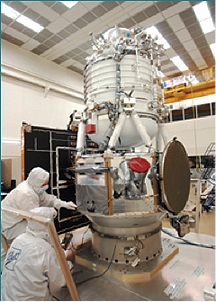
...a half billion stars, galaxies and other objects captured by the Wide-field Infrared Survey Explorer (WISE) mission. "WISE delivers the fruit of 14 years of effort to the astronomical community," said Edward Wright, WISE principal investigator at UCLA, who first began working on the mission with other team members in 1998.
WISE, built by Ball Aerospace & Technologies, launched Dec. 14, 2009, and mapped the entire sky in 2010 with vastly better sensitivity than its predecessors. It collected more than 2.7 million images taken at four infrared wavelengths of light, capturing everything from nearby asteroids to distant galaxies. Since then, the team has been processing more than 15 trillion bytes of returned data. A preliminary release of WISE data, covering the first half of the sky surveyed, was made last April. The WISE catalog of the entire sky meets the mission's fundamental objective. The individual WISE exposures have been combined into an atlas of more than 18,000 images covering the sky and a catalog listing the infrared properties of more than 560 million individual objects found in the images. Most of the objects are stars and galaxies, with roughly equal numbers of each. Many of them have never been seen before.
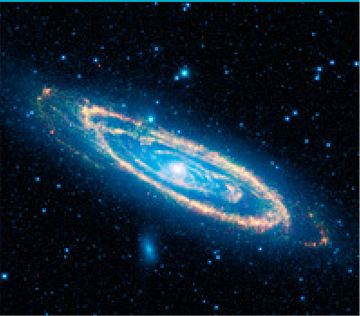
WISE captured this image of the immense Andromeda galaxy, also known as Messier 31 or simply M31.
Other discoveries were unexpected. WISE found the first known Trojan asteroid to share the same orbital path around the sun as Earth. One of the images released today shows a surprising view of an echo of infrared light surrounding an exploded star. The echo was etched in the clouds of gas and dust when the flash of light from the supernova explosion heated surrounding clouds. At least 100 papers on the results from the WISE survey already have been published. More discoveries are expected now that astronomers have access to the whole sky as seen by the spacecraft.