

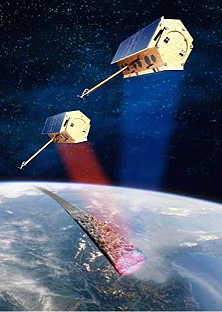
TanDEM-X, image courtesy of DLR
The first images demonstrate the satellite is in good working order and is ready to team up with the TerraSAR-X satellite launched three years ago. The pair of satellites will trace the variation in height across the globe with precision of better than 6 feet. The satellite will support a number of applications, such as navigational devices for military jets to allow them to fly at very low altitudes. Infoterra GmbH, which has exclusive rights to commercialize the TanDEM information, says the market for radar products is steadily growing.
The new images show regions of Ukraine, northern Madagascar and Moscow. The pictures illustrate the unique ability of the equipment to use radar to sense the planet’s surface. The satellite is able to detect, for example, the choppiness of the waves in the Indian Ocean near Madagascar. TanDEM-X will be flying in a polar orbit that will take it in a similar path to that of TerraSAR-X, about 325 miles above the planet. The intention is to have the new satellite maintain an extremely close path to its sibling. At times, the two satellites will be as close as 650 feet to one another. The radar works by bouncing microwave pulses off the ground and sea surface. By timing how long it takes for the signal to return to the satellite, the instrument can determine differences in height. Three-dimensional image acquisition is expected to start in January.
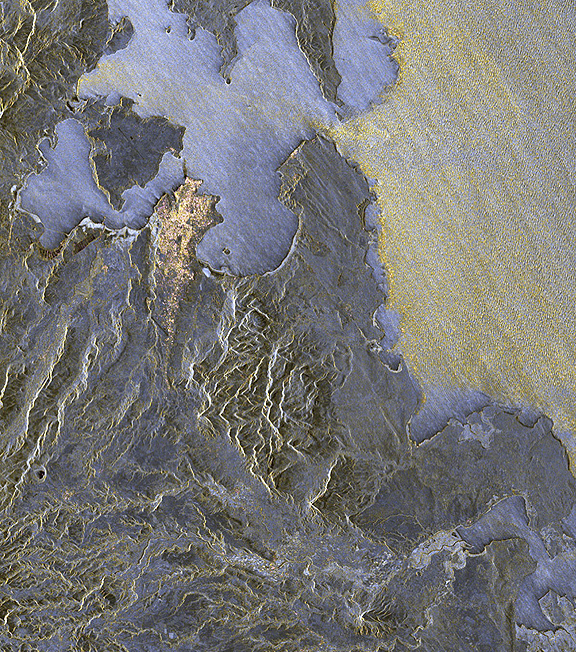
The ups and downs of the waves in the Indian Ocean (pale yellow) are charted by TanDEM-X as it flies over at a speed of seven kilometers per second. The change in the waves at the entrance to the Diego Suarez Bay is clearly visible. The water in the bay itself, on the shore of which the provincial capital, Antsiranana, can be recognized, is very flat — in contrast to the undulating ocean — and reflects the radar signals from TanDEM-X more uniformly. The area of valleys to the south drains the volcanic cone of Ambre-Bobaomby into the Indian Ocean. Credit: DLR.
The seamless digital elevation model (DEM) of the Earth’s surface will be built up over a period of three years. Ultimately, the satellites should be able to produce a vertical resolution of 3 to 6 feet and a spatial resolution of 40 feet, far superior to any global data recorded to date. The TerraSAR-X/TanDEM-X venture is operated on the basis of a public-private partnership. The Germany's space agency (DLR) owns the hardware; satellite manufacturer EADS Astrium has developed and built the technology; and Infoterra GmbH processes and sells the data.