

...Atlas V rocket has successfully completed a preliminary design review, another step toward the return of humans to space on a U.S. vehicle. This is the third milestone under the company’s Commercial Crew Integrated Capability (CCiCap) agreement with NASA that Boeing achieved on schedule.
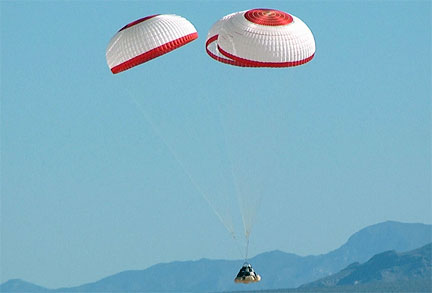
Three parachutes slow the descent of the Crew Space Transportation (CST)-100 during its successful drop test April 3 at the Delamar Dry Lake Bed near Alamo, Nevada.
Photo courtesy of Boeing.
“This review was an outstanding integrated effort by the Boeing, ULA and NASA teams,” said John Mulholland, vice president and program manager of Boeing Commercial Crew Programs. “It sets the baseline for us to proceed to wind tunnel testing and the launch segment review in June.”
Boeing completed two additional CCiCap milestones earlier this year: The Engineering Release 2.0 software release, which lays the groundwork for spacecraft control and communications, and the Landing & Recovery Ground Systems and Ground Communications design review, which establishes a plan for the equipment and infrastructure needed for ground communications and landing and recovery operations.
Boeing's Commercial Crew Program includes the design, manufacture, test and evaluation, and demonstration of an integrated Commercial Crew Transportation System—comprised of the CST-100 spacecraft, launch vehicle, and ground and mission operations—for NASA's Commercial Crew Development program. The Boeing system will provide crewed flights to the International Space Station and also support the Bigelow Aerospace orbital space complex.