

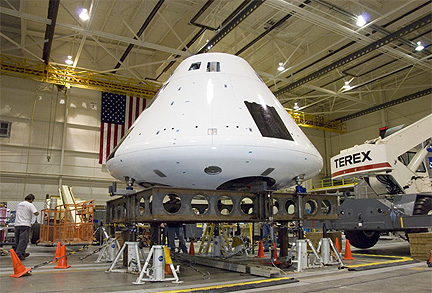
The Orion crew module, photo courtesy of NASA
The spacecraft is headed to Lockheed Martin’s Denver, Colo., facilities where it will undergo a series of rigorous tests to confirm Orion’s ability to safely fly astronauts through all the harsh environments of deep space exploration missions. Soon after the spacecraft arrives in Denver, it will be integrated with the heat shield and thermal protection backshell before undergoing environmental testing. This crew module will also go through a series of simulated landing scenarios at Langley’s new Hydro Impact Basin. The Langley facility will be used to test, validate and certify water landings for all human-rated spacecraft for NASA. Built to spaceflight specifications, this Orion ground test vehicle has already validated advanced production processes, equipment and tools required to manufacture the Orion crew module space flight hardware. Data collected from the testing and pathfinding operations will be incorporated to enhance design, requirements, tooling, processes, inspection and test that will ultimately result in a safe, reliable and affordable human-rated space exploration vehicle.
Orion has passed critical human-rating milestones, including Orion’s flawless flight test of its launch abort system and the successful phase one safety review that validated Orion meets many of NASA’s stringent requirements for safe human spaceflight. Lockheed Martin is the prime contractor to NASA for the Orion crew exploration vehicle – the nation’s next generation spacecraft that features advanced technologies for more complex and challenging human space exploration missions throughout our solar system. The Orion spacecraft will be comprised of a crew module for crew and cargo transport; a service module for propulsion, electrical power and fluids storage; a spacecraft adapter for securing it to a launch vehicle, and a launch abort system that will significantly improve crew safety.