

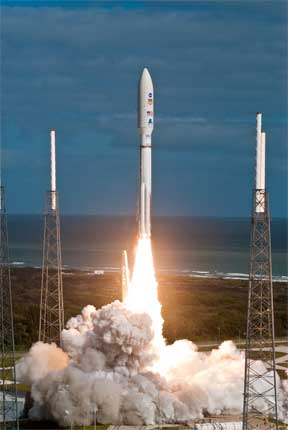
Cape Canaveral Air Force Station, Fla. (Nov. 26, 2011) – A United Launch Alliance Atlas V rocket blasts off from Space Launch Complex-41 at 10:02 p.m. EST with NASA’s Mars Science Lab rover Curiosity. This is ULA’s 11th launch of the year and marked the 56th successful launch for the company in 60 months. After landing on Mars in August 2012, MSL’s prime mission will last one Martian year (nearly two Earth years). Researchers will use the rover’s tools to study whether the landing region has environmental conditions favorable for supporting microbial life. Photo by Pat Corkery, United Launch Alliance
Representing ULA — United Launch Alliance Atlas V rocket blasts off from Space Launch Complex-41 at 10:02 p.m. EST with NASA’s Mars Science Lab rover Curiosity. This is ULA’s 11th launch of the year and marked the 56th successful launch for the company in 60 months.
"ULA is extremely proud to have launched the Curiosity rover on its 9-month journey to the red planet,” said Jim Sponnick, ULA vice president, Mission Operations. “The technological innovations on this extremely sophisticated MSL mission are most impressive and we are all looking forward to the operations and scientific learning on Mars starting next August.”
This mission was launched aboard an Atlas V 541 configuration vehicle, which includes a 5-meter diameter RUAG Space payload fairing along with four Aerojet solid rocket motors attached to the Atlas booster. The Atlas booster for this mission was powered by the RD AMROSS RD-180 engine and the Centaur upper stage was powered by a single Pratt & Whitney Rocketdyne RL10A engine. MSL is the last of five critical missions ULA launched for NASA within a six month period. “These five launches were launched both successfully and on-time as a result of the exceptional performance and teamwork demonstrated by the combined ULA, mission partner, and NASA Launch Services Program (LSP) team. We all look forward to these missions providing a much greater understanding of Earth’s climate, life on other planets, and the origins of our solar system,” said Sponnick.
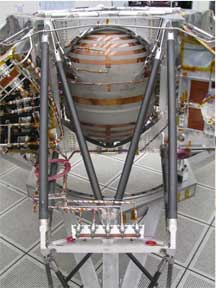
ATK products will also support the flight to Mars, the challenging landing on the Martian surface and the scientific exploration mission of the rover. ATK’s Commerce, California facility designed and built five propellant tanks that will power cruise thrusters to guide the spacecraft on its journey to the Red Planet, and the descent thrusters that will help it land safely on the planet’s surface.
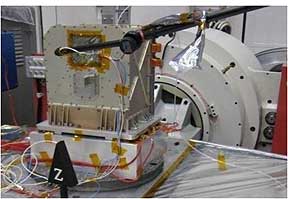
ATK also provided support in the development of the thermal subsystem that will protect Curiosity from the harsh environment it will encounter on the Martian surface. At a design review, it was described as the most challenging thermal design ever seen. The data gathered by Curiosity from rock and soil samples will help determine whether conditions are favorable for future missions that could send humans to Mars. The rover will use 10 science instruments to examine rocks, soil and the atmosphere. The mobile laboratory will carry the most advanced payload of scientific gear ever used on Mars’ surface according to NASA.
“I am extremely proud of our ATK teams for delivering mission success to NASA and the Jet Propulsion Laboratory, two of our long-standing customers,” said Ken Reightler, ATK VP of Engineering Services and a former NASA astronaut. “The dedication and commitment from our employees over the past two years reinforces NASA’s ongoing confidence in ATK to provide the highest level of engineering services support to the Mars mission.”
“We are honored to have been involved on almost every JPL/Mars mission,” said Gary Kawahara, ATK VP and General Manager, Space Structures and Components, Liquid Propulsion Products. “ATK’s diaphragm propellant tanks have demonstrated their reliability and safety on Mars programs from Mariner to Viking to the most recent Phoenix Lander. JPL chose ATK again for this critical mission based on our perfect track record of more than 5,550 total tank deliveries with zero failures. As the journey to Mars is now on its way, we will continue to lend our expertise on ensuring a successful landing.”
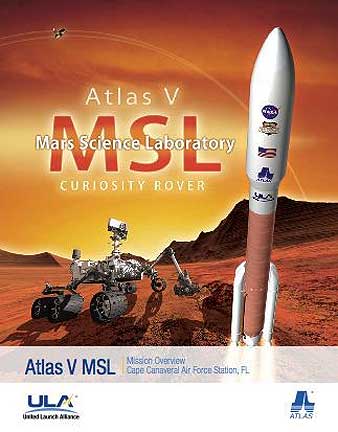
After landing on Mars in August 2012, MSL’s prime mission will last one Martian year (nearly two Earth years). Researchers will use the rover’s tools to study whether the landing region has environmental conditions favorable for supporting microbial life.
Following launch on an Atlas V 541 from Cape Canaveral Air Force Station (CCAFS), MSL will complete a nearly 9-month journey, landing on Mars in August 2012. The MSL rover and its sample acquisition system and suite of scientific instruments will spend at least the next two years analyzing the surface and atmosphere in an effort to determine the red planet’s habitability.
MSL is the last of five critical missions ULA is scheduled to launch for NASA in 2011. These missions will address important questions of science — ranging from climate and weather on planet Earth to life on other planets and the origins of the solar system.