 [SatNews] NASA Administrator Charles Bolden will visit an Orbital Sciences Corp. facility in Gilbert, Arizona, on Friday, August 9th., to view progress on the Orbiting Carbon Observatory 2 (OCO-2) satellite.
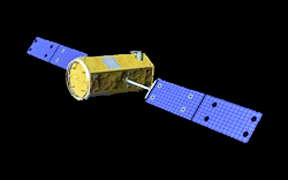 Artistic rendition of the OCO-2 satellite, courtesy of NASA.
At 8:15 a.m., MST, Bolden and Orbital CEO David Thompson will tour the company’s satellite manufacturing and clean room facility where the OCO-2 satellite is under construction. OCO-2 will be NASA’s first dedicated Earth remote sensing satellite to study atmospheric carbon dioxide from space. OCO-2 will collect global measurements of carbon dioxide with the precision, resolution, and coverage needed to characterize sources and sinks on regional scales, and quantify carbon dioxide variability over the seasonal cycles annually. OCO-2 is targeted to launch next year.
Additionally, Orbital Sciences Corporation has been selected by the National Aeronautics and Space Administration (NASA) to host a scientific payload that will improve spacecraft fire safety for future space exploration vehicles.
Known as the Spacecraft Fire Experiment (Saffire), the payload will be hosted aboard Orbital’s Cygnus™ advanced maneuvering spacecraft and is planned for flight by mid-2015.
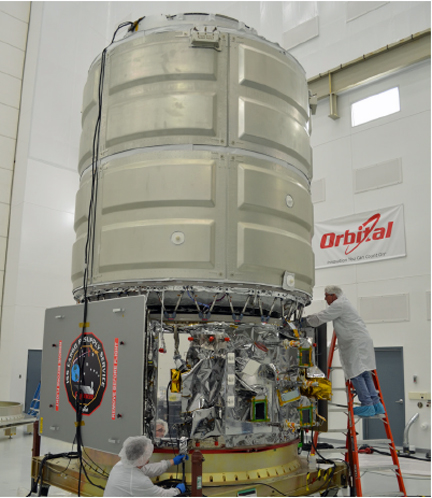 Cygnus spacecraft at the
Wallops Island, Virginia launch site.
Cygnus spacecraft at the
Wallops Island, Virginia launch site.
Photo courtesy of Orbital.
“While the primary mission of Cygnus is to deliver cargo to the International Space Station (ISS), Saffire will demonstrate the ability of Cygnus to provide important secondary mission capabilities, including as a platform to conduct a wide variety of experiments and demonstrations beneficial to the scientific and engineering community,” said Mr. Frank DeMauro, Orbital’s Cygnus Program Manager. “After completing its cargo delivery mission, Cygnus has the capability of remaining in space for months at a time and provide substantial power, data and propulsion support to hosted payloads. This affords researchers ample time to conduct experiments in a real-world space environment at an affordable cost, a very attractive feature for scientists looking to conduct short- to medium-duration research and for space industry communities developing flight heritage data for materials and systems.”
The self-contained Saffire payload, built by NASA’s Glenn Research Center (GRC), will test the flammability of large samples of various types of materials in low-gravity environments. It will be integrated into Cygnus’ Pressurized Cargo Module and remain in place throughout the duration of the cargo delivery mission. Orbital is currently under contract for one mission, but NASA is preparing three flight systems, Saffire I, II and III, each dedicated to a separate Saffire Cygnus mission. Saffire I will test one fabric sample, while Saffire II will test 10 fabric samples and Saffire III will test a hybrid of the Saffire I and II samples.
Topical Tags :
Regional Tags :

