

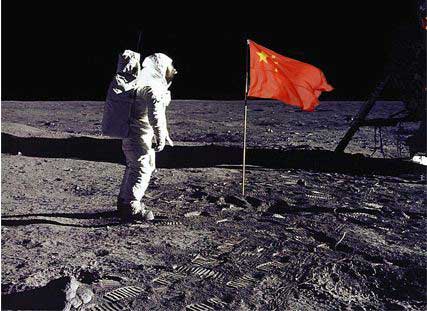
Such a strategic withdrawal represents a remarkable turnaround for a country that as recently as 2003 warned that China's "manned space efforts almost certainly will contribute to improved military space systems in the 2010-2020 timeframe".
So claimed a US Defence Department report called 'The Military Power of the People's Republic of China', which for good measure quoted Captain Shen Zhongchang of the Chinese Navy Research Institute as saying: "The mastery of outer space will be a requisite for military victory, with outer space becoming the new commanding heights for combat."
It would be easy to argue this report was a product of its time – when a paranoid Bush administration was looking for enemies to justify its controversial missile defence shield. But if anything the threat from China has increased since then.
In 2007 China shocked the world by becoming only the third nation to shoot down a satellite with a ground-based missile – demonstrating an ability to protect itself from spy satellites.
The US and the Soviet Union ran similar tests in the 1980s, but stopped, largely because of the menace of orbiting debris from the destroyed satellites. The Chinese space programme gets by on around $1.3bn per year - compared to Nasa's $17.6bn - but it is already proving an embarrassment to America. With a little more of China's undoubted financial might behind it, it could deliver a lunar base some time in the 2020s.
China is adamant any such base would be open to scientists from around the world. But would the Americans be able to swallow their pride and send scientists to a Chinese moon base?
Two months after China's satellite target practice, the former chief administrator of Nasa, Michael Griffin, testified to the US Senate: "The moon is very visible and any proposition by another country to set up a permanent presence there would be unacceptable to the Americans."
More recently, the messages coming from China have been mixed. Air force commander Xu Qiliang told the People's Liberation Army Daily in November 2009: "As far as the revolution in military affairs is concerned, the competition between military forces is moving towards outer space… this is a historical inevitability and a development that cannot be turned back."
Yet around the same time, China and Russia jointly submitted a proposal to the United Nations aimed at securing "a legally-binding agreement banning the deployment of weapons in outer space".
Last month Richard Fisher, a senior fellow at the International Assessment and Strategy Center in Virginia, warned of China's "scary space ambitions" in an article in the Wall Street Journal Asia. He reported claims that China could develop ‘assassin' and laser-armed satellites and may already be developing an ‘orbital bomber'.
Fisher also warned: "The PLA may also consider placing military assets on the moon." And he said future, larger, unmanned moon bases could be used to eliminate deep space American early-warning satellites.
Fisher's warnings came less than two weeks before Obama presented his budget and signalled the end of US manned space flight and, effectively, its interest in a moon base. Building such a structure would be all but impossible without astronauts on the lunar surface.
In 2006, President George W Bush released a Space Policy Document. It stressed that the US must "develop capabilities, plans, and options to ensure freedom of action in space, and, if directed, deny such freedom of action to adversaries".
At the time, the report was met with general dismay as the lunatic ravings of a warmonger. The Asia Times read: "The US is turning space into its personal colony." But with China seemingly the only participants in an undeclared space race, Bush's policy looks almost reasonable.
You can read this article at.