

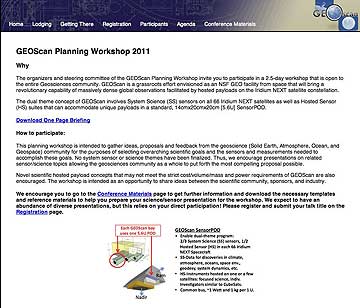
GEOScan will use hosted payloads on Iridium's next-generation satellite constellation, Iridium NEXT. The Johns Hopkins University Applied Physics Laboratory (APL) will host this event under sponsorship of the National Science Foundation (NSF).
To learn more . This GEOScan program is a grass-roots initiative to host an integrated array of scientific sensor suites as small payloads (up to 4 kilograms), known as "SensorPODs," on Iridium NEXT.
"Placing SensorPODs on Iridium NEXT is an innovative concept that would enable unparalleled visibility into Earth's atmosphere and space, providing an assessment of the impact of pressing scientific challenges, such as climate and atmospheric changes, that was never before possible," said Dr. Lars Dyrud, a senior scientist at APL. "The Iridium NEXT satellite replenishment program is an unprecedented opportunity to create a canopy of interconnected sensors covering the entire globe."
Scheduled for March 27-30, at the Historic Inns of Annapolis, the GEOScan workshop is intended to gather ideas, proposals and feedback from the geosciences community for the purposes of selecting overarching scientific goals and the sensors and measurements needed to accomplish them. The workshop will include presentations and discussions on missions and sensors. It will be followed by a half-day session on March 30 in which a steering committee will make tentative selections and recommendations for a proposal to the NSF.
"Reduced government funding for space programs will create a 'data gap' in Earth-observation programs that are critically important for the study of the Earth's atmosphere," said Dr. Om Gupta, director of strategic market development for Iridium NEXT. "The 2010 U.S. National Space Policy calls for public-private collaboration on missions where the public sector might not have the resources, and encourages federal departments and agencies to seek out nontraditional arrangements to leverage commercial capabilities."
"Iridium NEXT is not only our company's vehicle to the future, but for other organizations as well," added Dr. Gupta. The Iridium NEXT constellation will consist of 66 cross-linked, low-Earth orbiting (LEO) satellites intersecting over the north and south poles. The company expects to begin launching the new satellites in 2015. "Hosting scientific payloads as SensorPODs on Iridium NEXT offers a cost-effective choice for the scientific community to obtain a ride into space," he said.