

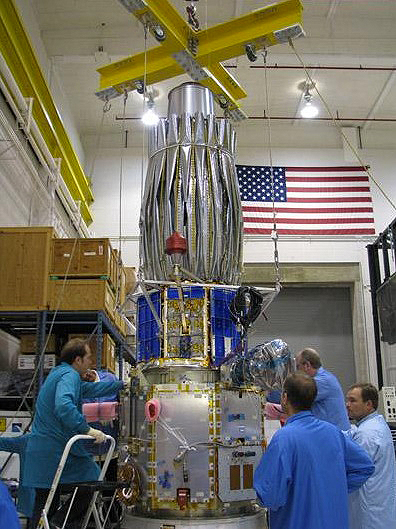
Environmental and Performance testing on the TacSat-4 payload
Photo credit: Naval Research Laboratory

Sierra Nevada Corporation’s (SNC) Space Systems has revealed its role in the recently-launched TacSat-4 mission. The Universal Interface Electronics (UIE) unit developed by SNC and launched as part of the TacSat-4 mission on September 27th. The UIE unit is a prototype of SNC’s distributed, modular avionics architecture developed as part of the DoD plug and play responsive satellite initiative. The primary purpose of the UIE device is to enable rapid interfacing of various devices with differing interface protocols via firmware reprogramming with the intent of eliminating expensive and time consuming hardware modifications and requalification. TacSat-4, sponsored by the Office of Naval Research, is the latest in a series of satellites intended to demonstrate an ability to rapidly deploy small, low-cost spacecraft that can meet the needs of military commanders at the theater level. It is part of a larger DoD initiative known as Operationally Responsive Space (ORS). SNC’s Space Systems group provided the satellite for the Air Force Research Laboratory’s (AFRL) TacSat-2 ISR satellite, which launched in December of 2006, and the SPA Avionics Experiment (SAE) payload on TACSat-3 that launched in May of 2009. With regards to the significance of the TacSat-4 experiment, Jeff Summers, SNC’s Space System’s VP of Technology, said, “The development and subsequent flight of the UIE on the TacSat-4 mission is important to SNC as it represents validation of the on-board processor base lined in all 18 of SNC’s commercial ORBCOMM Generation 2 satellites.”
Artistic renditions of various CCDev2 views