

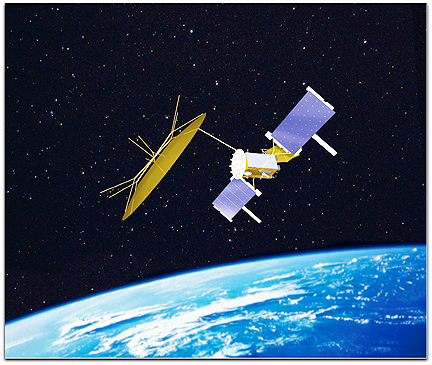
 The MUOS system module, developed and tested at Lockheed Martin's facilities in Newtown, Pennsylvania, includes a legacy UHF payload provided by Boeing Satellite Systems (BSS), El Segundo, California, that is compatible with more than 10,000 deployed UHF SATCOM terminals that will transition to MUOS as existing UHF Follow-on (UFO) satellites reach the end of their on-orbit life. It also features a Lockheed Martin-built wideband code division multiple access payload that incorporates advanced technology to provide a 16-fold increase over legacy UHF SATCOM in the number and capacity of satellite links. These technologies will support new mobile satellite terminals that are under development within the Joint Tactical Radio System.
The propulsion core contains the integrated propulsion system and serves as the structural backbone of the satellite. Developed and tested at Lockheed Martin's Mississippi Space & Technology Center, the propulsion subsystem is essential for maneuvering the MUOS satellite during transfer orbit to its final location as well as conducting on-orbit repositioning maneuvers throughout its mission life. The first MUOS satellite, along with the associated ground system provided by General Dynamics C4 Systems, Scottsdale, Arizona, are scheduled for on-orbit hand-over to the US Navy in 2011.