

 [SatNews] Well known for its advanced COFDM modular technology for terrestrial TV transmission and extremely high performance wireless links, TeamCast has also...
...invested in the single carrier transmission business with a portfolio of cutting edge and innovative ideas regarding spectrum purity, spectrum efficiency, and power efficiency for satellite transmission equipment.
Spectrum purity
TeamCast's unique digital output signal filtering provides unprecedented EVM and spurious performance in comparison with competition. This standard filtering permits compliance with the sharp roll off values used today.
Spectrum efficiency
With this standard, no option RF quality, 32 APSK constellations now become possible for satellite transmissions allowing improved capacity performances. Combining 32 APSK with lower roll-off values allow you to carry more payload at lower power on your satellite channels, at no additional cost.
Power efficiency
TeamCast has a unique expertise in digital precorrection of multi carrier signals (which are very demanding, due to the inherent high Power to Average Ratio of these signals) and we also have the unique ability to apply this technology to mono carrier signals, allowing the correction of channel distortions and thus increase your link budget margins.
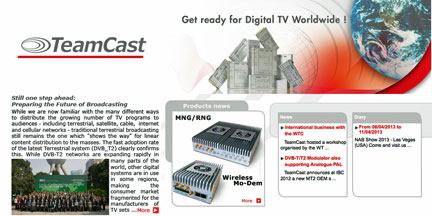
TeamCast will also be launching its MNG/RNG modem solution at NAB 2013 to enable clients to build strong and reliable mobile communications, for Video and Data Links applications.
Based on a versatile and compact modulator called MNG and a Diversity 4 MRC receiver called RNG, the modem offers a unique set of innovative features for insuring high flexibility and best-of-class performance in the field...
—Dual waveform operation (single carrier/DVB-S2 standard or enhanced COFDM/RUBY)
—Agile RF output from 1.95 to 3.6 GHz
—Dual ASI and Ethernet inputs for video and IP connectivity
—Up to 16 MHz channel bandwidths, for maximizing the useful bit-rate for the COFDM modes (up to 50 Mbps) in urban and rural situations
—More than 160 Mbps in the DVB-S2 modes for LOS (line-of-sight) transmission
—Ease of integration with embedded web browser and 10-36 VDC supply range
Additionally, TeamCast and CNES (the French National Center for Space Research) entered a new technical collaboration project early 2013...
where the main objective is to increase the efficiency of a standard 36/72 MHz transponderwhile remaining compliant with the established DVB-S2 standard. Three techniques will be jointly studied and optimized at the uplink modulator:
—linear signal pre-distortion for compensating satellite's input and output filters impairment
—non-linear signal pre-distortion for compensating satellite's TWT amplifier impairments
—use of low roll-off values
The first and third techniques will allow a better use of the transponder bandwidth edges, by reducing the unwanted side band signals, while the association of the first and second will allow the use of higher rate modulation schemes such as 16 APSK and 32 APSK. All together they will significantly increase the transponder efficiency (higher capacity in the same bandwidth). In this collaboration, CNES will bring their satellite chain expertise and test resources, such as their laboratory chain emulator, while TeamCast will bring their expertise in implementation of pre-distortion and filtering techniqueswell developed and widely proven in the COFDM terrestrial TV transmission. The outcomes of this collaboration are expected by fall 2013. In the meantime both partners are contributing to the definition of the future DVB-S3 standard.