

"We are going to put a larger satellite into space that can operate for one year and send data," Ahmadinejad said last Saturday, adding, "Iran plans to shoot satellites to altitudes of 700 km, then 1,000 km. Once this target is realized, placing a satellite at a geosynchronous orbit of 35,000 km will be easy." Ahmadinejad also said that the country would send man into space by 2025. He had also announced last month that the country plans to send a home-made measurement satellite into orbit in the near future. "Iran's measurement satellite will be launched into space from an Iranian launch-pad and will have an Iranian exchange station and control station," he said.
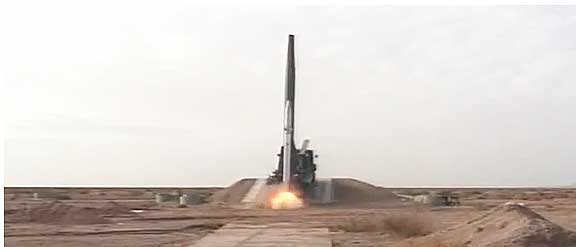
Iran's launch of the Kavoshgar-3 "biocapsule"
Ahmadinejad further noted Iran's plans for sending astronauts into space and said that the issue has gone under a second study at a recent cabinet meeting and that the plan will be implemented in 2019, five years earlier than the date envisaged in the original plan. The country sent the first biocapsule of living creatures (worms, a rat ,and a turtle, advanced living creatures, all) into space in February, using its home-made Kavoshgar-3 (Explorer-3) carrier. Omid (Hope) was Iran's first research satellite that was designed for gathering information and testing equipment. After orbiting for three months, Omid successfully completed its mission without any problems. It completed more than 700 orbits over seven weeks and reentered the earth's atmosphere on April 25, 2009. After launching Omid, Tehran unveiled three new satellites called Tolou, Mesbah II and Navid, respectively. Iran has also unveiled its latest achievements in designing and producing satellite carriers very recently.
Iran has recently unveiled a new generation of home-made satellites and a new satellite carrier called Simorgh (Phoenix). The milk-bottle shaped rocket is equipped to carry a 60-kilogram (132-pound) satellite 500 kilometers (310 miles) into orbit. The 27-meter (90 foot) tall multi-stage rocket weighs 85 tons and its liquid fuel propulsion system has a thrust of up to 143 tons. Iran is one of the 24 founding members of the United Nations' Committee on the Peaceful Uses of Outer Space (UNCOPUOS), which was established in 1959 — no, that is not a joke... although it should be... (Source: FARS News Agency)