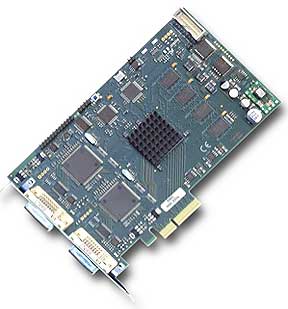
 DELTACAST has announced the DELTA-dvi-e 10, the latest addition to the DELTA-dvi range of video cards for OEM applications, and the industry's first single-channel dual-link DVI card. Designed as a cost-effective high-performance choice for professional broadcast and event applications using DVI or analog component video input, the DELTA-dvi-e 10 can ingest a dual-link DVI, DVI-A, DVI-D, HDMI, or analog component video source to a PC or server through one, 4-lane PCI Express slot. The DELTA-dvi-e 10 is supplied in a package with the VideoMasterHD OEM software SDK and with integration support from DELTACAST where required. Offering a feature set including enhanced E-EDID handling (persistent E-EDID, reconfigurable from DVI cable or through the SDK); automatic input format detection; 256-Mbyte onboard frame store memory; 1/2 size PCI Express card form factor; and the unified OEM VideoMasterHD SDK for all uncompressed OEM products in a Windows® or Linux environment, the DELTA-dvi-e 10 allows OEMs to build high-end applications that deliver dual-link DVI input at a single-channel price point. The DELTA-dvi-e 10 requires a PC or server with at least one free four-lane PCI Express slot and a high-performance CPU capable of handling dual-link DVI streams. The DELTA-dvi-e 10 will be available for purchase in September 2010.
Ericsson ConsumerLab has released the results of a recent study called “Multi Screen Media Consumption 2010”. Data was collected in China, Germany, Spain, Sweden, Taiwan, the UK and US. The sample in the study is representative of more than 300 million consumers. The study reveals that people are spending up to 35 percent of their leisure time watching TV and video content, and that consumers are becoming more aware of new technologies, which in turn are creating new patterns of media consumption. At least once a week, 93 percent are still watching scheduled “linear” broadcast TV, but the role of broadcast TV is changing owing to the introduction of new distribution channels. More than 70 percent of consumers surveyed are streaming, downloading or watching recorded broadcast TV on a weekly basis, and 50 percent are using internet-based on-demand TV/video every week. Broadcast live content is still important to consumers, but the ability to decide when and how to watch TV will affect the role of linear or scheduled broadcast content. Consumers are requesting a personalized, easy-to-use, high-quality, on-demand service without commercial breaks as their next TV service. Data shows a clear correlation between which features consumers find important and their willingness to pay for them. Today, the consumer spending is not proportionate to the viewing time invested. The average consumer spends EUR 38 per month on their TV viewing, and almost 60 percent of that relates to broadcast TV. However, since the time spent watching broadcast TV accounts for only about 40 percent of the total TV/video consumption, it is clear that consumers are not paying for what they use the most. Ericsson ConsumerLab findings show clearly that consumer spending will shift in the future, with a significant increase in on-demand spending, provided that consumer requirements for high quality, ease of use and access to the right content are met. The study also covers consumers’ attitudes to the touch screen tablet and how it fits into their TV consumption; 37 percent are very interested in using a tablet as a remote control.
Home Gateway Initiative (HGI)’s second annual test event, which will take place from November 22 to December 3 in the UK, will continue to focus on the performance and capabilities of the Home Gateway, including quality of service and multi-session support, and will also feature software modularity and IPv6 testing for the first time. During the event, vendors select which tests they will participate in — once the test results have been reviewed and validated between the vendor and the HGI auditing team, the vendors will be free to use the audited results as they wish, while the HGI management committee will publish an anonymous summary of the results. The test plan is due to be finalised at HGI’s Q3 meeting, which will take place from September 27 to October 1 in Vancouver, Canada.
Pulsar TV has launched their new HD + 3G + 3D Ready Freedom Mobile Truck. Pulsar will be the first company to broadcast live in HD from Argentina. The new mobile build includes a Ross Vision Octane Multi-Definition Production Switcher, XPression Character Generator and openGear Terminal Equipment. Their first broadcast will be to air the Women’s Hockey World Cup starting in August in Rosario City.

Sky (British Sky Broadcasting Limited) has extended the term of its existing license agreement with Rovi Corporation (NASDAQ: ROVI) for interactive program guide (IPG) patents. The multi-year agreement provides Sky with a license to the Rovi IPG patent portfolio for Sky’s pay television service platforms. Specific terms of the agreement were not disclosed. The Rovi global licensing program also includes European pay TV operators and suppliers: NDS, KDG, CANAL+, Portugal Telecom, SKY Italia, and UPC Broadband, among others.