

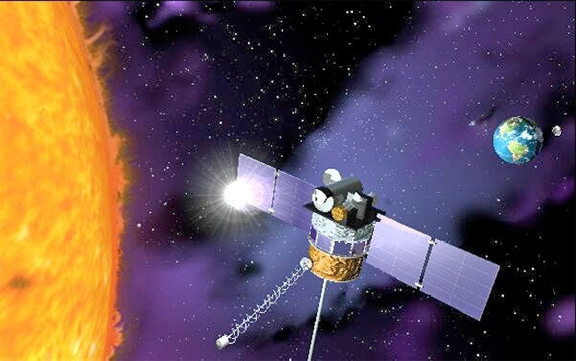
Artistic rendition of NOAA's DSCOVR spacecraft, courtesy of NASA.
Passing the review, called the Key Decision Point C, confirms DSCOVR can meet requirements within its planned life cycle cost and on its projected schedule.
DSCOVR will orbit at the L1 libration—a stable point in space where gravitational forces are in equilibrium—approximately one million miles away from Earth between the Earth and the sun. From that location, the satellite can pinpoint solar storms before their impacts reach the planet.
DSCOVR is a partnership between NOAA, NASA and the U.S. Air Force.
NOAA will manage the DSCOVR mission, giving advanced warning of approaching solar storms with the potential to cripple electrical grids, communications, GPS navigation, air travel, satellite operations and human spaceflight. According to a National Research Council Report, experts estimate damages from the most extreme types of these solar storms could range between $1trillion-$2 trillion over 10 years.
NASA, funded by NOAA, refurbished the DSCOVR satellite and instruments, which were in storage for several years. The U.S. Air Force is funding and overseeing the launch of DSCOVR, which will be aboard a SpaceX Falcon 9 rocket.
NOAA’s mission is to understand and predict changes in the Earth's environment, from the depths of the ocean to the surface of the sun, and to conserve and manage our coastal and marine resources. For more information about NOAA satellites, please visit www.nesdis.noaa.gov and follow us on Facebook, Twitter and our other social media channels.