

 [SatNews] A significant new capability for the company's state-of-the-art statistical multiplexing technology, Flextream™ 2.0, has debuted.
Flextream 2.0 now has the ability to integrate variable bit-rate data streams within the video pool. The benefits are immediate: whenever the data bit-rate decreases, Flextream 2.0 automatically reallocates the freed bandwidth to the video to optimize bit-rate usage within a multiplex.
Thomson Video Networks' statistical multiplexing technology automatically controls the company's ViBE™ MPEG-2/4 SD or HD encoders by dynamically allocating video bit-rates according to quality targets and service priorities. In this manner, it significantly optimizes bandwidth utilization and improves the resulting video quality, which is a continuous requirement for satellite DTH, terrestrial or cable networks.
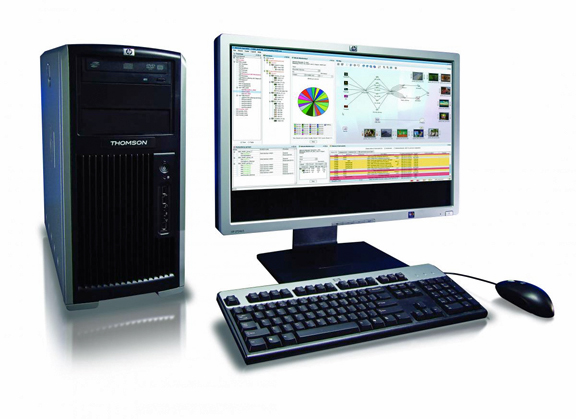 Flextream 2.0 extends this technology to intermittent data streams; instead of reserving a fixed amount of bandwidth within the multiplex for passing these streams, Flextream 2.0 dynamically adapts the video pool bit-rate based on the quantity of data to be transmitted, up to a predefined threshold. Ideal for asynchronous data components or services, Flextream 2.0 offers a cost-effective and safe solution for broadcasting EMM, EPG, and interactive applications such as HbbTV (Hybrid Broadcast Broadband TV), system software updates, and playout of VOD programs.
Flextream 2.0 applies a complementary approach to Opportunistic Data Insertion (ODI). Instead of adapting the data bit-rate to the audio/video services, it adapts the video pool bit-rate to the amount of data to broadcast (up to a predefined threshold). It also comes with monitoring utilities that notify operators when the data streams exceed their maximum allowed bit-rate.
As Flextream 2.0 reallocates every unused data packet to video transmission, it optimizes the usage of the bandwidth within a multiplex and improves the overall perceived video quality whatever the encoding format, including MPEG-2/4. As a result, the Flextream 2.0 technology now allows operators to take advantage of every packet of a multiplex for conveying data or video. It also simplifies the operational workflow; for example, it's no longer necessary to modify multiplex configurations each time there's a need to broadcast a higher amount of data, such as an overnight transmission. Instead, the system automatically adapts to real-time conditions.