[SatNews] From BeOn To LTE to the State of Oregon...
Harris Corporation (NYSE: HRS) has announced that its BeOn™ has become one of the industry's first solutions to enable public safety subscribers on a cellular or public safety LTE network to talk to each other, exchange text messages and pass real-time location information to connected team members and the dispatcher's computer-assisted dispatch (CAD) system. The BeOn software application delivers Push-To-Talk (PTT) voice over 3G cellular and commercial and public safety LTE networks – providing users with the integrated P25 (Project 25) feature set, including voice, text messaging and location services, making it the ideal solution for a variety of public safety communication users.
With BeOn, voice communication services are delivered to first responders as voice-over-IP (Internet Protocol) data packets using wireless broadband IP data services. As BeOn brings a traditional LMR functionality to a software-based network data service, BeOn can run across a variety of IP-based broadband networks, including commercial and public safety LTE networks. Harris combined its experience in LMR with the interoperability of its VIDA™ IP-based network to develop the BeOn solution for public safety. The innovative PTT solution designed to provide interoperable, P25 communications to first responder agencies. The Harris VIDA network platform is a unified IP-based voice and data communication system based on APCO P25 industry standards. VIDA delivers full IP management features, including interoperability without intervention of console operators, IP consoles and other benefits inherent in open IP architecture systems. VIDA enables high-performance PTT over commercial wireless networks, as well as seamless interoperability with legacy and future LMR systems.
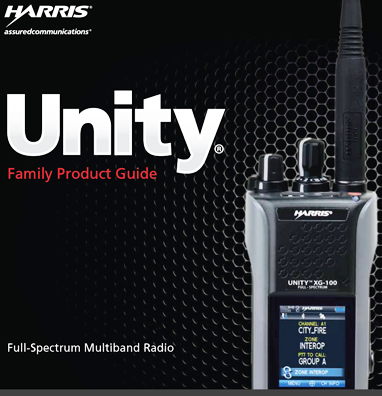
Harris has also received a $50 million work order contract from the Oregon Department of Transportation (ODOT). This contract will find the Company delivering public safety radios, technology and services for the Oregon State Radio Project, which will support the mission-critical communications needs of ODOT and the Oregon State Police. This is the first work order under a larger master pricing agreement that is part of the multi-phase Oregon State Radio Project. The program includes those systems currently operated independently by the ODOT and the Oregon State Police, and initiates an integrated statewide network that will allow Oregon to comply with the federal narrowbanding mandate that governs spectrum use for land mobile radio (LMR) systems. The contract for the radio project includes the purchase of 6,800 Unity XG-100 portable and mobile multiband radios to deliver true interoperability for first responders. The Unity XG-100, which features a graphical color display, Bluetooth accessories and integrated GPS (Global Positioning System), supports virtually all four public safety LMR frequencies licensed in North America, allowing state, local, county, tribal and federal radio users throughout Oregon to communicate on-scene without the need for outside assistance.
As part of the radio project, a P25 (Project 25) trunked 700 MHz radio system will be deployed in select densely populated metro areas to maintain and enhance overall system coverage and support interoperable, public safety communications. The trunked P25 system will be fully integrated into the state system infrastructure and will be the initial IP (Internet Protocol) backbone that Oregon can expand in the future for statewide communication.
Among communications systems already in place in the state, interoperability will be increased via gateways to achieve statewide roaming that will facilitate communications between federal, tribal, county, local and state agencies. The project network will include the installation of Harris MASTR® III base stations at existing ODOT and OSP transmission sites, including a number of mountaintop locations across the state. Additionally, critical repairs will be made to existing ODOT and OSP sites as required to protect new equipment.
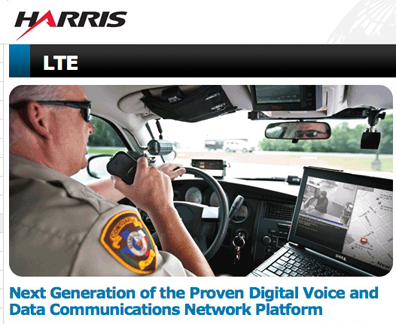
Harris's LTE solution for public safety is now operational within the 700 MHz Public Safety Broadband Demonstration Network. The Public Safety Communications Research (PSCR) program provides manufacturers and first responders with a multi-vendor, neutral host environment for interoperability and application testing for LTE (Long-Term Evolution) technology and solutions. Harris Corporation in partnership with Nokia Siemens Networks provided 700 MHz LTE network infrastructure to the NIST (National Institute of Standards and Technology) testing lab in Boulder, Colorado. The complete Harris 700 MHz LTE solution for Public Safety provides first responders with the capability to ensure voice, data and video availability in both large-scale emergencies and day-to-day operations. Harris LTE also delivers secure, private and prioritized mobile broadband connectivity, and a common communications environment that brings together public safety broadband, cellular carrier and LMR communications on a single infrastructure platform. Harris 700 MHz LTE networks support a wide range of existing and emerging high-bandwidth applications such as streaming video, advanced situational awareness and PTT (Push To Talk) voice-over-broadband features. The networks also provide users with priority and Quality of Service (QoS) controls, user authentication and air link encryption, advanced load balancing and Self-Optimizing Network Management.