

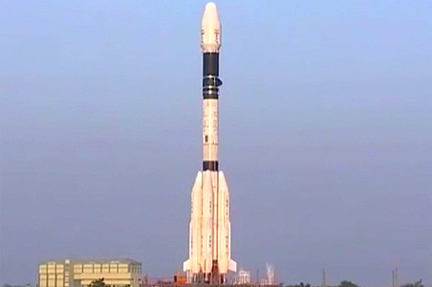
 India's Geosynchronous Satellite Launch Vehicle (GSLV) is ready for liftoff. If all goes well, it will mark India's entry into the multi-billion dollar commercial launcher market on a fully indigenous rocket.
A sophisticated new Indian technology called the cryogenic engine will be flown for the first time. In the five earlier flights, India had used pre used imported Russian made cryogenic engines. "For the first time, we are testing the cryogenic engine and stage in the flight. It has to perform well. Only when we achieve it then I can say, India has done it, the sixth country in the world to have this complex cryogenic engine technology," said Dr. K. Radhakrishnan, Chairman, Indian Space Research Organization (ISRO).
It took India more than 15 years to develop this cryogenic engine as technology for this was denied. In the 1990s, America put pressure on Russia and forced the cancellation of an Indo-Russian technology transfer deal. The argument given was that India will use these engines to make missiles. Two decades later, none of the Indian missiles uses a cryogenic engine. A team of hundreds of scientists toiled day and night to master this technology. The new cryogenic engine powers the Indian made, 3-stage Geosynchronous Satellite Launch Vehicle, which stands 50 meters tall. That's as high as a 25 storey building and weighs in at 416 tons.
After a 17-minute flight, the satellite is put into its designated orbit above Earth. This 330-crore mission will hoist a sophisticated communications satellite called G-Sat which is an Indian made experimental satellite that weighs 2200 kg and should will improve the global positioning system. It will also test a new electrical propulsion system to keep the satellite in its orbit. It is also carrying a set of Ka-band transponders, which will increase the quality of television coverage. (Source: NDTV)