[SatNews] Partnerships are being sought to help manage two of this space agency's upcoming major challenges.
The agency is, of course, NASA which is seeking partner organizations to manage the upcoming Night Rover and Nano-Satellite Launcher Centennial Challenges. NASA's Centennial Challenges are prize competitions for technological achievements by independent teams who work without government funding. The challenges are extended to individuals, groups and companies working outside the traditional aerospace industry. Unlike most contracts or grants, awards only are made after solutions are successfully demonstrated. "We're looking for allied organizations that recognize the tremendous value these citizen-inventor, entrepreneur, small business and
university teams bring to the innovation engine in America," said Bobby Braun, NASA chief technologist at NASA Headquarters in Washington. "Centennial Challenges is another catalyst for the United States to out-innovate the rest of the world in a new, technology-based economy."
Teams competing in the Night Rover Challenge will need to demonstrate a solar-powered exploration vehicle that can operate in darkness, using its own stored energy. The objective of the Night Rover Challenge is to stimulate innovations in energy storage technologies of value in extreme space environments, such as the surface of the moon, or for electric vehicles and renewable energy systems on Earth. Currently, the solar-powered Mars rovers "go to sleep" during the Martian night. NASA hopes the Night Rover Challenge will generate new ideas that will allow planetary rovers the ability to take on a night shift, and possibly create new energy storage technologies for applications on our home planet. NASA is offering a prize purse is $1.5 million for the rover challenge.
The Nano-Satellite Launcher Challenge is to place a small satellite into Earth orbit, twice in one week, with a prize purse of $2 million. The goal is to stimulate innovations in low-cost launch technology for frequent access to Earth orbit while encouraging creation of commercial nano-satellite delivery services. Decreasing the cost of reliably sending small payloads to Earth orbit in a timely manner could create entire new markets for U.S. businesses and provide opportunities for students and researchers to harness the environment of space for technology development and innovative problem solving.
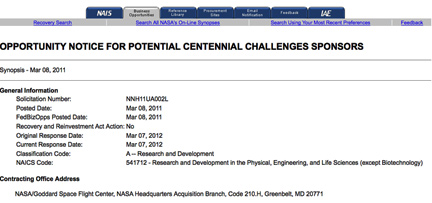
Centennial Challenge events typically include media and public audiences, and may be televised on NASA Television or streamed online. NASA's agency website also covers the competitions. The competitions provide high-visibility opportunities to partner organizations and sponsors for public outreach. NASA will select U.S. non-profit organizations to manage the contests from proposals in response to agency opportunity notices available at: http://go.usa.gov/40P and http://go.usa.gov/49N.