

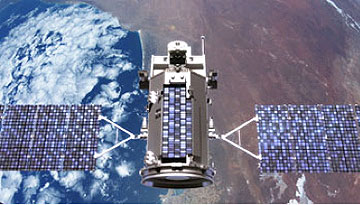
The Glory satellite, image courtesy of NASA
Data provided by the innovative Aerosol Polarimetry Sensor (APS), which will fly aboard NASA's Glory spacecraft, will help scientists better understand how aerosols impact global climate patterns. "The Glory Aerosol Polarimetry Sensor can distinguish between various types of aerosols and reveal the different role each plays in either warming or cooling our planet," said Bill Hart, vice president, Space Systems. "With this information, policy leaders can make better-informed decisions with regard to addressing seasonal and regional climate change events."
The sensor comprises 161 optical elements, including six precision-aligned telescopes that analyze light of varying wavelengths, from visible to shortwave infrared. On orbit, the APS will make comprehensive measurements from multiple viewing angles in multiple spectral bands. The APS design incorporates polarized and non-polarized references to assure high accuracy under the full range of operating conditions. "Since black carbon aerosols generally contribute to warming, and sulfate aerosols to cooling, the concentrations of these aerosols and others must be determined to ensure accurate climate modeling," said Hart. "Because these particles are transported over long distances by winds, their effects on climate are best studied through space-based observations."