

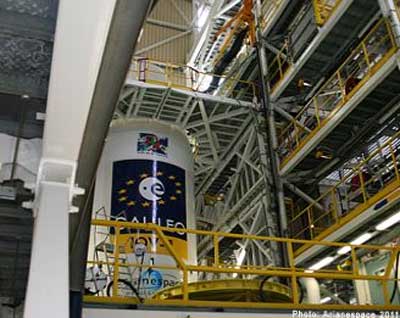
This photo – taken in one of the service gantry’s upper levels – shows the payload fairing containing Soyuz’ two Galileo satellites. Visible around it are the work stands that provide access to the launch vehicle.
A full dress rehearsal for Arianespace’s first Soyuz flight from French Guiana was performed today, validating the mission from countdown to spacecraft separation in preparation for this Russian-built launcher’s historic liftoff on October 20 with two Galileo satellites.
Today’s dress rehearsal provided one of the final verifications for this milestone flight – designated VS01 in Arianespace’s launcher family numbering sequence – offering a realistic representation of the mission, including flight-following by ground tracking stations of the three-stage Soyuz and its Fregat upper stage.
It incorporated a simulation of the two telemetry streams from the three-stage Soyuz launcher, from which initial data treatment is performed on-site at the Spaceport by its Russian producer, the Samara Space Center-TsSKB Progress; along with telemetry from the Fregat upper stage, which was sent to the flight monitoring center of manufacturer NPO Lavochkin in the Moscow region, where Arianespace personnel are present for the data readout.
Jean-Claude Garreau, Arianespace’s Launch Site Operations Manager for the VS01 mission, said all remains on schedule for Soyuz’ Thursday morning liftoff from the Spaceport on a 3-hr. 49-min. flight to deploy its two Galileo IOV (In-Orbit Validation) satellites into a 23,222-km. circular medium-Earth orbit, inclined 54.7 degrees.
The fully-integrated Soyuz is on its pad at the ELS launch complex in the Spaceport’s northern sector, which continues to undergo final preparation procedures while the launcher remains protected by a purpose-built mobile gantry. In parallel, members of the Galileo team are managing the satellites’ status with activity that includes balancing the electrical charge on the spacecraft batteries.
Liftoff of the Soyuz is scheduled at 7:34:28 a.m. on October 20 – a precise timing that enables the two Galileo satellites to be injected into their proper orbital plane. This pair of IOV satellites, along with two others to be orbited by Soyuz in 2012, will form the operational nucleus of Europe’s full 30-satellite Galileo navigation constellation.
The Galileo network is designed to provide highly accurate, guaranteed global positioning services. It was developed in a collaboration of the European Space Agency and European Union, and was conceived to be interoperable with the U.S. Global Positioning System and Russia’s Glonass network.
Both IOV spacecraft to be launched on Soyuz’ maiden flight were built by a consortium led by prime contractor EADS Astrium with Thales Alenia Space, and they weigh approximately 700 kg. each.
You can follow Arianespace's launch activity at