


On April 18, Northrop Grumman completed a ground demonstration of a communication system that would allow the U.S. Air Force's B-2 stealth bomber to operate with the Advanced Extremely High Frequency satellite network. A new Northrop Grumman-developed active electronically scanned array antenna, shown in the photo, was the technological centerpiece of the demo.
Northrop Grumman is the Air Force's prime contractor for the B-2, the flagship of the nation's long-range strike arsenal, and one of the world's most survivable aircraft. The company conducted the tests at EHF frequencies using secure transmission techniques. The test team plans to repeat the laboratory demos in the near future using other B-2 satellite terminal candidates, including a government-furnished Family of Beyond Line-of-Sight Terminal. The AEHF engineering model payload is representative of EHF satellite payloads currently on orbit. It is used by the U.S. Air Force, Navy and Army to test new EHF satellite terminals prior to testing them with operational satellites.
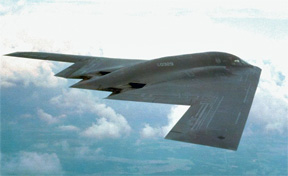
The B-2 Bomber, photo courtesy of Northrop Grumman.
Following completion of the current AEHF laboratory demos, Northrop Grumman plans to demonstrate the ability of the AESA antenna and a terminal to communicate directly "over the air" with an operational AEHF satellite.
The B-2 is the only long-range, large-payload U.S. aircraft that can penetrate deeply into access-denied airspace, and the only combat-proven stealth platform in the current U.S. inventory. In concert with the Air Force's air superiority fleet, which provides airspace control, and the Air Force's tanker fleet, which enables global mobility, the B-2 can help protect U.S. interests anywhere in the world. It can fly more than 6,000 nautical miles unrefueled and more than 10,000 nautical miles with just one aerial refueling, giving it the ability to reach any point on the globe within hours.