

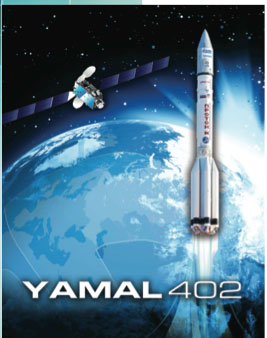
Scheduled for launch on Saturday, December 8, at an orbital location of 55° East longitude, the Yamal 402 communications satellite will provide services to Russia, CIS countries, Europe, the Middle East and Africa.
The all Ku-band satellite will have 66 equivalent 36 MHz transponders, which will compose 4 fixed beams (Russian, Northern, European, Southern) and 1 steerable beam. JSC Gazprom Space Systems has ensured the development of the ground infrastructure based on ground stations and technical control means provided by Thales Alenia Space. With the addition of the Yamal 402 JSC Gazprom Space Services will strengthen their position in the global satellite industry.
The Proton M launch vehicle, utilizing a 4-burn Breeze M mission design, will lift off from Pad 39 at Baikonur Cosmodrome, Kazakhstan, with the Yamal 402 satellite on board. The first three stages of the Proton will use a standard ascent profile to place the orbital unit (Breeze M upper stage and the Yamal 402 satellite) into a sub-orbital trajectory. From this point in the mission, the Breeze M will perform planned mission maneuvers to advance the orbital unit first to a circular parking orbit, then to an intermediate orbit, followed by a transfer orbit, and finally to a geostationary transfer orbit. Separation of the Yamal 402 satellite is scheduled to occur approximately 9 hours, 15 minutes after liftoff
Satellite Operator: Gazprom Space Systems
www.gazprom-spacesystems.ru
Satellite Manufacturer: Thales Alenia Space
www.thalesaleniaspace.com
Platform: Spacebus 4000C3 Separated Mass: 4463 kg Satellite Mission Lifetime:15 Years
Proton History Proton Description„
- Lead designer was Vladimir Chelomei, who designed it with the intention of creating both a powerful rocket for military payloads and a high-performance ICBM. The program was changed, and the rocket was developed exclusively for launching spacecraft.
- First named UR-500, but adopted the name “Proton,” which also was the name of the first three payloads launched.
- Proton launched Russian interplanetary missions to the Moon, Venus, Mars, and Halley’s Comet.
- Proton launched the Salyut space stations, the Mir core segment and both the Zarya (Dawn) and Zvezda (Star) modules for today’s International Space Station.
- First commercial Proton launch — 9 April 1996.
- First commercial Proton M Breeze M launch — 30 December 2002