

....from the Herschel Space Observatory, a European Space Agency-led mission with important NASA contributions; and NASA's Spitzer Space Telescope. The new images map the dust in the galaxies known as the Large and Small Magellanic Clouds, two of the closest neighbors to our own Milky Way galaxy.
The Large Magellanic Cloud looks like a fiery, circular explosion in the combined Herschel-Spitzer infrared data. Ribbons of dust ripple through the galaxy, with significant fields of star formation noticeable in the center, center-left and top right (the brightest center-left region is called 30 Doradus, or the Tarantula Nebula, for its appearance in visible light). The Small Magellanic Cloud has a much more irregular shape. A stream of dust extends to the left in this image, known as the galaxy's "wing," and a bar of star formation appears on the right.
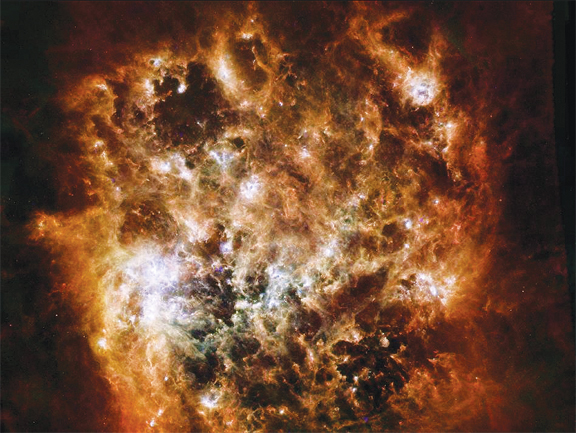
This new image shows the Large Magellanic Cloud galaxy in infrared light as seen by the Herschel Space Observatory, a European Space Agency-led mission with important NASA contributions, and NASA’s Spitzer Space Telescope. In the instruments' combined data, this nearby dwarf galaxy looks like a fiery, circular explosion. Rather than fire, however, those ribbons are actually giant ripples of dust spanning tens or hundreds of light-years. Significant fields of star formation are noticeable in the center, just left of center and at right. The brightest center-left region is called 30 Doradus, or the Tarantula Nebula, for its appearance in visible light.
The colors in this image indicate temperatures in the dust that permeates the Cloud. Colder regions show where star formation is at its earliest stages or is shut off, while warm expanses point to new stars heating surrounding dust. The coolest areas and objects appear in red, corresponding to infrared light taken up by Herschel's Spectral and Photometric Imaging Receiver at 250 microns, or millionths of a meter. Herschel's Photodetector Array Camera and Spectrometer fills out the mid-temperature bands, shown here in green, at 100 and 160 microns. The warmest spots appear in blue, courtesy of 24- and 70-micron data from Spitzer. Image credit: ESA/NASA/JPL-Caltech/STScI
The Large and Small Magellanic Clouds are the two biggest satellite galaxies of our home galaxy, the Milky Way, though they are still considered dwarf galaxies compared to the big spiral of the Milky Way. Dwarf galaxies also contain fewer metals, or elements heavier than hydrogen and helium. Such an environment is thought to slow the growth of stars. Star formation in the universe peaked around 10 billion years ago, even though galaxies contained lesser abundances of metallic dust. Previously, astronomers only had a general sense of the rate of star formation in the Magellanic Clouds, but the new images enable them to study the process in more detail. The results were presented at the 219th meeting of the American Astronomical Society in Austin, Texas.